If arriving by ferry, Ketchikan is likely to be a visitor’s first view of the travel wonders of Alaska. Supposedly the wettest town in Alaska, the harbour is packed to the gills with boats visually highlighting the rich fishing traditions of this historic Alaskan city. Ketchikan is woven along its shoreline with nothing more than a couple of blocks from the water as the land rises sharply out of the ocean.
 Packed with people if the cruise ships are in, the highlight of the town is Creek Street (top photo), a boardwalk and string of houses built over Ketchikan Creek. Seemingly patrolled by a lone sea-lion, Creek Street originally served as the red-light district bringing entertainment and relief to the men who spent many weeks away at sea. The most infamous, Dolly’s House continues today as a museum to the world’s oldest profession, while most others have turned into tourist shops selling items as bizarre as Australian opals.
  At the top end of Creek Street is a fish ladder to help salmon climb past the tiny falls and return to their point of birth. The Married Men’s Trail is a rough path through the forest that allowed discrete entry to the red-light district, the single men being able to walk straight along the walkway. A funicular tram off Creek Street saves a sharp walk up the hill and offers a great view across Ketchikan Harbour.
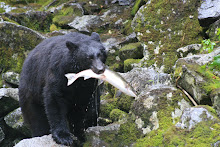
 Salmon abound in the harbour as witnessed by the local Indian population pulling in a couple while I simply stood and watched for a few minutes. While visitors need licences to fish, the local Indian population are entitled to catch enough salmon to feed their family.
 Apart from a liberal sprinkling of totem poles throughout the town (helping to preserve a dying Indian art), the most interesting location is the Hatchery and Eagle Centre. The centre shows the process of breeding salmon (a couple of different varieties) for the markets while a couple of injured bald eagles, unable to fly, spend their years in the relative comfort of an enclosure with care, food and shelter. For many Americans, this is their first chance to see their national emblem in real life.
With time, a visit to the mesmerising and appropriately-named Misty Fjord National Monument with narrow fjords and sheer towering rock faces with plunging waterfalls. It is only accessible via boat or float-plane.
Ketchikan is far more pleasant without the floods of tourists disgorged from huge cruise ships so spend a night and enjoy this sample of Alaskan life.
Other Alaskan Posts
Bear Heaven (Anan Creek)
Feeding Frenzy (Anan Creek)
Misty Fjords - Bears, Crabs and Eagles on the African Queen
Receding River of Ice (Juneau)
Hey, Good Looking (Brown Bear)
Wednesday, January 13, 2010
The Salmon Capital of the World (Ketchikan, USA)


Sunday, January 10, 2010
Photo of the Week - Little White Church (Elbe, USA)
 Measuring just 24 feet by 18 feet (8x6 metres), the Little White Church or Evangelical Lutheran Church is not found in Germany, but in the tiny village of Elbe near Seattle. Claimed by Ripley's Believe It or Not to be the smallest church in the USA, (though this is heavily disputed), the church continues to conduct monthly services. Capable of seating 46 churchgoers and built in 1906 by German settlers, the church is set on a backdrop of towering trees and continues to carry its German signage. The elegant steeple stands 46 feet high and contains a bell taken from an early train.
Thursday, January 7, 2010
Experience a Wild Night at Currumbin Wildlife Sanctuary (Australia)

guest post by Gagandeep Singh Day tours are fun, but taking a tour in the night will reveal a whole new side of Australia that the day tours miss. This is because 75% of Australian wildlife is nocturnal, so if you see them at all it will be in a specially lit house and they will be asleep. How exciting it is to see these lovely little creatures in their natural habitat. You can get to see them they go about their natural business of finding dinner and otherwise living life as normally as possible.
To do this you need a guide who knows the likeliest places to find them. He will have a strong torch to spotlight the creatures as they scurry about in the bush, foraging and playing. You’ll be amazed at the variety there is. You will also be able to view closely one of Australia’s nocturnal birds in its natural bushland setting. And watch the tiny sugar-gliders as they leap through the dark night and glide from tree to tree. Luckily, being in the spotlight of a torch does not affect them in any way. The kangaroos at Currumbin Wildlife Sanctuary are tame enough to pet and feed; don’t be afraid but get up close to these gentle creatures. Also get close – but not too close – to that ugly but amazing little creature, the Tasmanian Devil. To keep your fingers safely attached to your hands, qualified personnel are the only ones allowed to feed them. Wombats are largely nocturnal too, although some do trundle about during the day. Usually they can only be glimpsed on the side of the road as you flash past in a car, but here at Currumbin you are sure to see them up close.
Another entertaining part of this tour is the section where you can watch an Aboriginal Tribal Corroboree– telling a story through dance and song – acted out in the starlight, and some expert didgeridoo playing. One of the biggest saltwater crocs on display lives at this sanctuary, so you will also be able to pay him a visit – not too close though – and see other freshwater crocodiles. You can even cuddle a koala here if you haven’t done it anywhere else, but the cost is not included in the tour, so you’ll need to fund that yourself. But don’t miss it in case you don’t go to another place where this experience is offered. Cuddling a koala is one of the favourite pastimes of tourist and local visitor alike.
Gagandeep Singh work for Brisbane Australia which provides latest accurate Information about Brisbane Hotels, Events, Tours and Things to do in Brisbane.
Sunday, January 3, 2010
Bountiful Bled (Slovenia)

 Chomping into the local delicacy of an impossibly rich vanilla and cream pastry (called kremna rezina) and a steaming black coffee on a vivid sun-drenched morning, it is difficult to imagine a more sublime place to be than at a café at medieval Bled Castle. Perched precipitously on a bare rock face, this ancient but uninteresting castle overlooks the glittering turquoise glacial Lake Bled with its fairy-tale island church, and glorious snow-capped alpine vista.
 This touristy village in the very north of Slovenia, a pocket-sized country wedged between Austria, Croatia and Italy swells with neighbouring European travellers. Officially over 1000 years old (having celebrated its millennium in 2004), Bled like all of Slovenia has a vibrancy and energy in its youthful population and in the progress this tiny nation has made in the last decade.
  Most popular is a visit to Bled Island and the Church of the Assumption. Walk past the hotels in Bled lining the lake to catch a squat gondola-like craft called a pletna, propelled by a local poleman. As you stride up the 99 steps from the dock, spare a thought for grooms who are expected to carry their wife up to the church to show they are fit for marriage. Enchantingly, the wife is meant to remain silent for the journey.
The church bell almost constantly chimes from its tower, echoing across the lake. Local legend dictates that those who ring the bell will have their wishes come true. Clearly many superstitious folks visit Bled!! Rowing on Lake Bled continues to be popular, with international regattas regularly conducted on the marked rowing course.
Around Bled are lush fields, growing feed for the harsh winter months. Note the unique fence-like structures used as hayracks to dry the grasses for storage. An excellent half-day hike from Bled is through Vintgar Gorge where a boardwalk hugs the rock wall, weaving back and forth across the raging river and tumbling water below. The gorge finishes a kilometre and a half down the boardwalk with the impressive Šum Waterfall which holds the delightfully alliterative name of Slap Šum in Slovene.
 Picturesque Bled is a real treasure, a true travel wonder. Take your time, stroll around the lake, rest and relax in the local cafés and soak up the easy going attitude of this lakeside mecca.
Other Slovenia Posts
Underground Fantasy (Skocjan Caves)
Caverns, Crooks and Castles (Predjama)
The Secret Hospital (Cerkno)
Friday, January 1, 2010
Drinks Around the World: Green Mint Tea (Morocco)
 At the start of every month, Travel Wonders highlights a special drink from my travels around the world. Mint Tea is a cultural tradition in Morocco served both with meals and to welcome guests. Travelling through the Saharan country several years ago, I practically lived on mint tea drinking several glasses per day. It was strangely invigorating in the humid sticky weather and gave a comforting break from the hectic roaming, sales pressure and harassment in the overcrowded souks. When discussing a sale of a larger item such as a carpet or artwork, mint tea is often served before the rounds of vigourous bartering commence. A refusal is considered disrespectful, tea being so culturally significant in Moroccan hospitality.
To make Moroccan mint tea, start by adding boiling water to a strong green tea (gunpowder tea is preferred). Swirl around the pot and after a minute or so, pour out all the water to wash the tea. Add a handful of spearmint leaves and a generous scoop of sugar (the Moroccans drink their tea extremely sweet) to the pot and fill the pot with boiling water. Leave to steep for several minutes. Pour into simple small glasses, often with a mint leaf or two in the bottom.
Tradition states that there should be enough in the pot for at least three glasses of this sweet tasty liquid. In any case, the hosts continue to fill your glass of the syrupy refreshing tea with exaggerated extravagent technique, lifting the pot high above the glass but with no spillage. The Moroccans claim that over the three glasses, the flavour changes over time as the tea steeps in the pot. One favourite local saying to describe change is:
The first glass is as bitter as life,
the second glass is as strong as love,
the third glass is as gentle as death.
Photo: Source