Ludwig von Beethoven is undoubtedly one of the finest musicians and composers who has ever lived. He is rightfully remembered with a grand white obelisk and grave. Ironically, his close friend and fine composer Franz Schubert was an attendant at his funeral and died a year later, being buried next to Beethoven. Also buried among this music royalty in Musician's Corner of Vienna's peaceful and leafy historic Central Cemetery (Zentralfriedhof which despite its name is a long way from the centre) are Strauss and Brahms.
Tuesday, March 15, 2011
Photo of the Week: Beethoven Grave (Vienna, Austria)


Saturday, March 12, 2011
Petroglyphs and Totem Poles (Wrangell, Alaska)

 Wrangell has a strange, slightly ramshackle frontier mood. With only a very rare cruise liner unleashing their human cargo in this Alaskan town, Wrangell has a peaceful easy-paced feeling and none of the fancy jewellery and trinket shops around the docks that towns like Ketchikan and Juneau have.
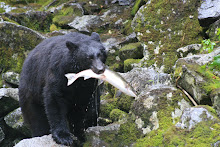
Outside of the turbulent and wild Stikine River and the exceptional wildlife experience watching brown and black bears fattening on salmon at nearby (50 kilometres away by boat) Anan Creek, Wrangell has two interesting sights in town both related to their Indian past. Around a mile north of Wrangell is Petroglyph Beach, full of strange carvings in rocks around the high-water mark. Several bald eagles nests line the road to the beach. Estimated to be around 8,000 years old, the area an estimated forty to fifty carvings, some simple spirals or stylised faces and others more sophisticated fish or sea creatures. While some are on rocks out in the open, some remain hidden by the lapping tides and others seek shelter under grassy fringes edging the beach. In a kind of treasure hunt, it is an enjoyable hour checking around rocks on this remote and unkempt beach trying to unearth more of these ancient carvings or to interpret their possible meaning.
  A boardwalk area includes reproductions of a few of the better examples to encourage people who take rubbings to use these as a protection for the originals that are slowly being warn away by the inevitable tidal erosion.
Little appears to be known for the reasons behind the local Indian carvings. Various explanations include markings of a good hunting or fishing area, a thank-you to the gods for bountiful hunts, a celebration for a battle victory or the simple joy of artistic expression. Near to the docks is Chief Shakes Island including a number of totem poles and a central communal hall called the Tribal House of the Bear. The title of Chief Shakes (now largely ceremonial) is handed down with the Tlingit Indians have overseen four separate ruling nations (including the Indians themselves). The Russians signed an agreement with them to trade furs in the area before the British and finally the Americans took control of the area.
  The central house is surrounded by a number of grandly carved totem poles, featuring a variety of animals and symbols. My personal favourite are the three frogs peering from their wooden perch through the foliage while a friendly bear lays prone on another pole. The three frogs totem pole represents shame to a neighbouring clan who had three of their young men have sex with three of Shakes clan’s women and yet not support the resultant children.
While best as a base for two superb adventures to Anan Creek bear-viewing and the Stikine River, Wrangell offers a quiet sprawling town with two unusual sights marking the rich Indian cultural history of the area.

Tuesday, March 8, 2011
Bat Problem (Sydney, Australia)

 The immediate east of the city of Sydney is flanked by magnificent parklands and gardens. The Royal Botanic Gardens started as the first farm in Australia in 1788 and became Australia’s first botanic gardens in 1816 (founded by the visionary Governor Macquarie), less than 30 years after the colony was settled. Trees from the original days still remain in the magnificent open gardens and many thousands stroll around and through the gardens every day. Eminent folks such as the Queen and the Pope have planted memorial trees over the years and in spring the gardens are a riot of colour and a perfumery of aromas.
 The gardens are home to the stunning but incongruous Government House, built in the 1840s like a Gothic Castle. Until recently, it was the home to the Governor of New South Wales but now is purely ceremonial (free guided tours are available most Fridays).
The gardens are also home to many thousands of native Grey-Headed Flying Foxes (or Fruit Bats). As innocent as these delightful bats appear resting upturned in the trees shrouded by their wings and with inquisitive faces, they have sadly continued to destroy a number of the century old trees in the gardens. The problem is how to encourage the flying foxes to move to new surroundings. It is impossible to capture over 20,000 flying foxes and move them to somewhere (they are likely to simply fly back anyway!!). In the next few months, the gardens are going to launch a few weeks of playing loud unpleasant recorded sounds during their sleeping hours including engine noises, crashing metal and sounds of predators to chase these irritating creatures to roost in other groves of trees away from the gardens. To avoid the issue of the bats simply settling in the neighbouring Hyde Park or other nearby attractive areas, the same sounds are going to be played in these locations as well.
 While the noise is bound to destroy the tranquil beauty of these superb gardens for a short while, it hopefully will provide a suitable solution to both preserve and naturally relocate the endangered flying foxes and preserve and protect the wonderful old trees of the gardens.

Saturday, March 5, 2011
Photo of the Week: Grand Canyon Sunset (USA)
 The rocky splendour of one of the travel wonders of the world is at its most mesmerising at sunrise (see Grand Canyon sunrise) and sunset. This shot is taken at the ideal sunset lookout of Hopi Point highlighting the powerful erosional forces of wind and water over the millennia. Every few minutes the colours change as the canyon's rock temples shadow the sinking sun plunging parts in darkness while other peaks and ridges gleam in warming hues of reds, oranges and bronzes.
Suggestion: Other great sunset vantage points include Mojave and Pima points.

Wednesday, March 2, 2011
Drinks Around the World: Caipirinha (Brazil)

Sitting in a quiet bar overlooking the dazzling vista of Iguazu Falls, I can hardly imagine a more refreshing drink than a Brazilian caipirinha. Simply mash small chunks of lime and sugar together in a glass. Add lots of ice and a special distilled sugar-cane alcohol called cachaça and the drink is complete. The same drink is also made using other tangy fruits including lemons and passionfruit.
The lime and cachaça provide a superb contrast of sweet and sour and makes for a tangy thirst-quenching drink in the humid falls climate.
In Australia, I have enjoyed on several occasions a variation called caipiroska made on vodka instead of the Brazilian cachaça.
While I've never seen a caipirinha outside of Brazil (it wasn't even available on the Argentinian side of the falls!), make sure you check out the national drink of Brazil.
----------
At the start of each month, Travel Wonders highlights a characteristic drink experienced on his travels. Other offerings from South America include coca tea from Peru and the famous Pisco Sour, available over much of South America.
Photo Credit: caipirinha
Subscribe to:
Comments (Atom)