Throughout history, large walls surrounded many cities to protect their citizens and leaders from siege and attack. Sadly, most of these city walls have gone either torn down by attackers, removed by cities to allow expansion or simply taken apart to provide building materials for more useful buildings.
Spain has an impressive number of cities whose complete (or near-complete) city walls (or muralla) are so significant, well preserved and impressive that they merit UNESCO World Heritage listing. All are rich in history with four of the five can be easily visited as day trips from Madrid.
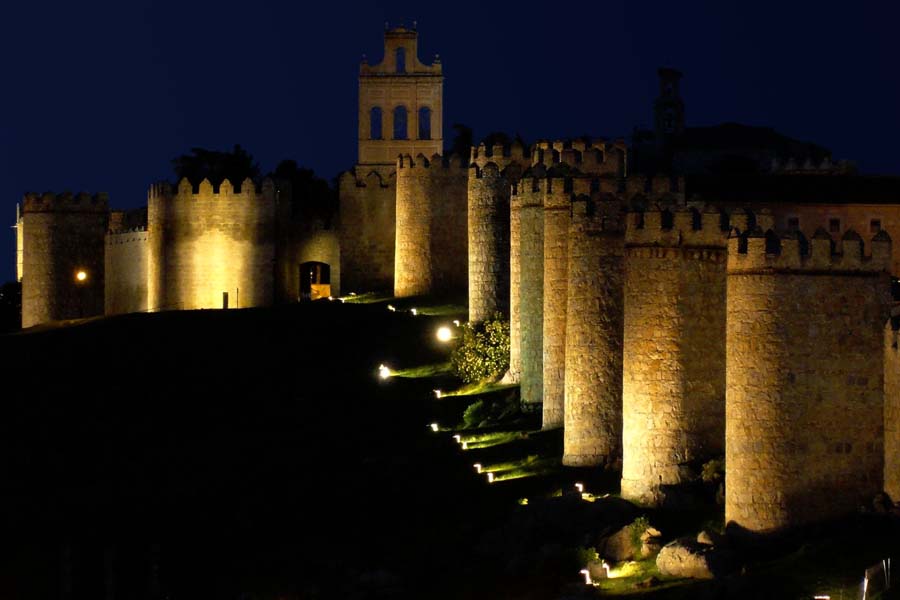
Ávila (Avila) Not that far from Madrid, the city of Ávila is impressively located perched on a high plain that rears sharply from the arid treeless surrounds. With a domination of churches, monasteries, convents and basilicas under the name of the ascetic Saint Teresa (whose mummified hands are in one of the churches), the pious city was subjected to battles for centuries between the Muslims and the Christians. The 12th century construction of 2.5 kilometres of superbly maintained walls, 88 towers and 9 gates eased the battles and today the exterior makes for a superb walk. At night the elegant crenellations add a regal imposing look to the city while three parts of the walls can be walked for a closer look.
Segovia Near Ávila, Segovia is an enchanting small honey-coloured city strategically perched on a rocky outcrop and encased in an 11th century wall. With history dripping around every corner of its narrow lanes, its undoubted highlights include a towering double-arched Roman aqueduct that cuts through the city, a cavernous cathedral and the fairytale Alcazar (and the world’s oldest existing industrial plant with the 1583 Mint). The Alcazar is an evocative 900 year old royal palace that emerges majestically from a rocky crag, its long narrow shape, sheer sides and witches-hat roofs being the inspiration for Sleeping Beauty’s residence.
Toledo Immortalised by El Greco and a former capital city, Toledo is a treasure trove of medieval buildings and cultural sights. Dating back to Roman times and ideally sited for fortification with a loop in the river protecting three sides and two imposing walls protecting the fourth, the city is jam-packed in a maze of streets with places of worship for Christians, Jews and Muslims, highlighting its wars and battles over past centuries. Toledo makes for a superb one day trip from Madrid walking the labyrinthine laneways soaking the medieval charm of so many historic structures.
Cuenca Just east of Madrid and encased by deep gorges on three sides, Cuenca was purpose built for fortification. More famous than its city walls are its exceptional hanging houses (las casas colgadas) grimly clinging to the cliff sides, their balconies protruding into fresh air and highly unsuited for those uncomfortable with heights. One excellent example now serves as the Abstract Arts Museum.
Lugo In the very north-west of Spain and surrounded by over two kilometres of Roman walls built in the third and fourth centuries (yes, over 1700 years old), it is the only complete Roman wall anywhere in the world. With the wall being six metres thick and with a twenty metre wide moat around the walls, Lugo was near impregnable. Eighty-five towers rise out of the wall giving vantage points in every direction to give the city warning of any pending attack.
While there are a number of examples of walled cities throughout Europe, north Africa and Asia, Spain has an impressive concentration of them, each making for a superb one-day visit. Other Spanish cities including Girona and Badajoz also boast well preserved city walls. While all the cities have sprawled well beyond their medieval bounds, it is a chance to imagine the importance that these walls bought in protecting the city and the efforts that leaders went to maintain the city against the constant threat of attack.
Photo Credits: Avila Night, Avila Walls, Toledo, Cuenca, Lugo
Sunday, October 30, 2011
The Walled Cities of Spain


Thursday, September 8, 2011
Escape the Crowds in Barcelona (Spain)
 guest post by Thomas Lukjaniec
Countless numbers of tourists flock to Barcelona each year to catch a glimpse of world famous sights and landmarks such as the Sagrada Familia, Las Ramblas and the Camp Nou. This often leads to swarms of tourists clogging up the city centre (especially during the summer months) and ignoring the many wonderful things there are to see and do that are just a stone’s throw away from the Catalan capital. So, if you’re planning a trip to Barcelona, or if you’re already there, then here are five worthwhile ways to escape the crowds.
Montserrat This breathtaking mountain is situated just an hour so away from Barcelona and is a must see for all those travelling to the city. It proudly boasts UNESCO World Heritage Site status and rises majestically to 1235m above sea level boasting panoramic views of the surrounding terrain. However, the main attraction is the mysterious formation of rocks found here and the beautiful Royal Basilica. Tours to the mountain are available all year round.
Sitges
Sitges (top photo) is where locals go to unwind on their days off - a strong recommendation indeed. It is the perfect place to escape the tourist infested beaches of Barcelona. This charming little town is situated just 40km outside of the city and is easily accessible by train. It’s well known as an historic centre with beautiful beaches, a peaceful ambiance and a thriving gay community. It is a true jewel of the coast and is ideal for families and friends to spend a fun and relaxing afternoon.
Illa Fantasia This water park is located just a 45min drive from Barcelona city centre and makes for a great way to cool down from the sweltering heat during the warmer months of the year. With lots of wet and windy slides, picnic areas and eateries, a trip here is ideal for families, couples and groups of friends looking for a fun day out. Julia Travel will get you entrance, as well as travel to and from the park, at a very reasonable price!
Hot Air Balloon Tear yourself away from the sights of Barcelona for one day and treat yourself to something unusual by taking a ride in a hot air balloon. Take in unrivalled views of the city from above and enjoy an experience that is truly unforgettable.
Barcelona Cruises
Taking a cruise from Barcelona is the ultimate way to see the city before setting sail on to other stunning Mediterranean destinations. Another excellent option is catching a ferry to one of the nearby Balearic Islands (Mallorca, Menorca and Ibiza), which offer one of either the perfect party or peaceful getaway from the city.
So there you have it - five fantastic ideas to escape the tourist crowds in Barcelona! All that’s left is organising accommodation for your stay in the city. It’s a good idea to base yourself centrally, where the fantastic transport system will allow you to reach all of these destinations with ease. Renting apartments in Barcelona is often a popular choice amongst visitors and will allow you to live close to these transport links, thus leaving you free to explore all of these wonderful places at your convenience.
Photo Credits: sitges, basilica, water park, balloon
Saturday, September 3, 2011
Sicily: Culture and History (Italy)

guest post by Katherine Conlan
Those looking for a cultural trip in a sunny climate should consider the largest island in the Mediterranean Sea, Sicily. Looking like the sharp piece of rock being kicked by Italy’s heeled boot, Sicily is a modern island with a rich history, and a fantastic place to explore by car. Comparing car rental rates and organising your own transport from one of the four airports before you get there will leave you free to start your tour as soon as you arrive. Palermo, the island’s capital, is a real cosmopolitan city and its long history (including occupation under the Phoenicians, Roman and Byzantine Empires, Arabs, Normans and Spaniards) can be seen scattered across its streets. The twelfth century Cathedral of Monreale is an Italian national monument and one of the most spectacular examples of Norman architecture in existence. The interior is covered in mosaics (made up of around 2200 kilos of pure gold), and among the depictions of saints and kings is one of the first portraits of Thomas Becket following his murder in Canterbury Cathedral in 1170.
 The Capuchin Catacombs of Palermo is an extraordinary place to visit. Now a popular tourist attraction, the catacombs were originally intended for burying Capuchin friars when the monastery’s cemetery became too full in the sixteenth century. As time went on burial here became a symbol of status, and wealthy residents asked to be preserved in the catacombs in their finest clothes. Around 8000 mummies line the walls, and one of the last people to be buried here is now the most famous: two year old Rosalia Lombardo who died of pneumonia in 1920 and has been so remarkably preserved she looks as though she is only sleeping.
 On the east coast of the island is that familiar 10,922 foot tall active volcano, Mount Etna. There are a number of mountain treks with fantastic valley views to choose from depending on the time available and the level of difficulty, and although walking around the summit is obviously not advisable, cable cars get visitors close. Most trips around the south side of Mount Etna depart from the port city of Catania, around 130 miles drive from Palermo. Catania has had its fair share of trouble, being destroyed by earthquakes in 1169 and 1693 and Mount Etna’s violent eruption in 1669. After these catastrophes the city was rebuilt in Baroque style and is now home to World Heritage-listed architecture. You may wonder why the city was continuously built up at the foot of an active volcano; the reason being volcanic ash makes exceptionally fertile soil for farming.
 Two hours’ drive south from Palermo near the city of Agrigento is the UNESCO World Heritage Site the Valley of Temples. This huge site includes the remains of seven Greek temples in varying degrees of preservation, two almost complete and others with only their columns still standing. Their different uses as places to celebrate weddings and pray for health give a nice insight into the social history of the period surrounded by the grandeur.
Sicily is full of cultural and historic highlight which can be enjoyed in sun-drenched comfort of this Mediterranean highlight reel.
Katherine Conlon likes to a get a feel for the history of the places she visits, and seeks out the bits which reveal something about the culture in different areas of the globe. She has travelled in four different continents and is looking forward to exploring the rest.
Photo Credits: etna, cathedral, catacombs, etna, agrigento

Tuesday, August 23, 2011
The Wonders of Easter Island

guest post by Rachel McCombie
Enigmatic Easter Island lies in the South Pacific, some five hours off the coast of Chile. It’s said to be the most isolated inhabited place on Earth, giving it an aura of inaccessibility which belies the fact that, thanks to regular commercial flights, a trip to this evocative island is by no means limited just to the most intrepid travellers.
 Though the sheer mission of travelling to the most remote corner of the Earth is an attraction in itself, the real draw of the island is the iconic statues for which it is famed. Known in the local dialect as the moai, these monolithic figures represent deified ancestors and are thought to have been carved between around 1250 and 1500 AD. There are a staggering 887 of them, many of which are still set in the hillsides of the quarry from which the compressed volcanic rock was taken to create them. The most impressive, however, are those which stand lined up on ceremonial platforms known as Ahu. These are to be found on the coast around the island, with the figures facing inland keeping watch over their living clan. The heaviest weighs an impressive 86 tons; to put that into perspective, the heaviest of the standing stones at Stonehenge is only 30 tons!
 The history of Easter Island is steeped in mystery. Nobody knows for sure when the first settlers arrived, though DNA tests have shown that the present-day Easter Islanders are of Polynesian descent and probably arrived in large numbers. Indeed, legend tells of a people displaced from an island being enveloped by the sea. When they first came ashore after their long ocean voyage, archaeological evidence shows that they would have found an island paradise rich in flora and fauna – a vision quite at odds with the barren landscape which characterises the island today. For this reason, Easter Island is often seen as a stark reminder of the effects of human occupation on fragile ecosystems; overpopulation and deforestation have left the island with virtually no trees and an economy which relies heavily on tourism. However, with UNESCO World Heritage status, the island draws in around 50,000 visitors a year – a figure expected to rise over the next decade – making tourism a reliable source of income for the remaining islanders.
 So, what is it actually like to visit Easter Island? Well, there’s no getting away from the fact that the journey is a lengthy one. First you have to get to Santiago, Chile, and from there it’s another five hours or so by plane to Easter Island’s airport at Hanga Roa. But this is not difficult to arrange, and once you’re there, you’re certain to deem the slightly arduous journey more than worthwhile. Arguably the best method of exploring the island is on horseback, and horses, bikes, scooters and jeeps are all available for hire. The ideal way to visit Easter Island is as part of a longer trip, perhaps incorporating other Pacific Islands (there are flights to Tahiti from Easter Island) or South America. This will enable you to make the most of being out in this remote part of the world. Many operators of tailor-made holidays run optional extra trips to Easter Island as part of a visit to Chile; Audley Travel, for instance, offer Easter Island tours as part of a South America itinerary. But however brief your visit, this truly unique island is guaranteed to leave you awestruck, with the inscrutable faces of its astonishing statues etched into your memory for life.
Rachel is a keen travel writer who has written about her experiences in numerous countries, from France to Japan. You can see more of her writing on her Rome blog.
Photo Credits: sunset, two faces, moai backs, moai
Saturday, July 23, 2011
Photo of the Week: Colourful Lion Guard (Kathmandu, Nepal)
 In a scanned photo from a trip some years ago, I love the colours of this mythical lion guarding one of the numerous temples in Durbar Square in the heart of Kathmandu. Durbar Square is a full assault on the senses - saffron-robed Sadu priests, a living goddess, occasional monkeys and people all in a square awash with historic pagoda-style Hindu temples, some with quite startling erotic carvings.
Extremely well dressed students battle with hawkers selling all kinds of accoutrements and paraphernalia, men coaxing tunes from enchanting singing bowls and pious older folks trying to simply pray in the Kathmandu mayhem. Somewhat voyeuristic, I'd suggest finding a cafe a few floors up and enjoy a cup of steaming masala tea and some quiet contemplative moments and watch the fascinating scenes of Kathmandu life unfold before you.

Saturday, June 11, 2011
Wartburg Castle: A Thousand Years of German History (Eisenach, Germany)

 The unrelenting climb up the forested slopes outside Eisenach (whether by foot, donkey or shuttlebus) past the towering plain walls highlights the imposing location of Wartburg Castle. Shaped like a cigar (click layout to enlarge) with one narrow gated entrance and with such natural defences, Wartburg Castle has played a significant role in German history and is a powerful symbol of the Reformation. Almost a thousand years old, the castle is a pot-pourri of building styles and architecture and has played witness to some of the most significant aspects of German history.
 A tour of the castle focuses on the historic Palace (or Palas), built in the 1100s. On the ground floor are the cavernous Knight’s Hall and Dining Room along with the unusual Elizabeth’s Bower. The room was encrusted with glistening mosaics last century in memory of Saint Elizabeth who in a remarkable but short life married Wartburg’s owner in the early 1200s, donated to the poor her entire life, reputed had bread taken from the castle for the poor miraculously turn to roses, died at age 24 and was canonised by the church only four years later. An entire passage way details her life in a sequence of murals.
 The first floor includes the chapel and the Hall of Minstrels where a famous singing competition (a kind of 13th century American Idol) were conducted resulting in a Wagner opera (Tannhäuser) centuries later and a beautifully painted room with excerpts from medieval. Six of the finest voices competed, with the poorest effort to be punishable by death (which would focus the practice sessions to say the least!!). The top floor is a grand festival hall that continues to be used and which leads to an excellent museum.
  The highlight of Wartburg is undoubtedly the Bailiff’s Lodge and Luther’s Room. It includes a modest wood-panelled room where Martin Luther in 1521, excommunicated from the Church (after nailing his demands to a Wittenberg church), hid as the Knight George or Junker Jörg (as the portrait behind the desk shows) and translated the bible into German (in a frenzied ten weeks). Sadly the furniture isn’t original but it is a moving location, and a pilgrimage site to many. Witness and feel how a man in disguise changed German and Christian history and culture, a change that continues to affect the world today.
Luther bought commonality to the German language, a new branch to Christianity (Lutherians) improved methods in translation and bought the words of the most powerful book in Christendom to the common people. Two centuries later Goethe, the father of German language, worked at Wartburg bringing a more modern Bible translation.  In 1817 as detailed by a beautiful woodblock painting, Wartburg Castle was the central rallying site for students protesting for German unity (Burschenschaften). Having hidden Luther and having recently defeated Napoleon, Wartburg was an ideal symbol for German nationality and was the source of the black, red and yellow tricolour that became the German flag a century later.
 Enjoy the grounds and the various buildings before taking a final walk up the South Tower, which offers a superb view of the tiny township of Eisenach, the castle grounds and the Thuringian Forest. Wartburg Castle is UNESCO World Heritage Listed and one of Germany’s finest travel wonders. View a thousand years of architecture and history where a saint lived her short life, Martin Luther made his dramatic impact on Christianity and students protests led to the eventual unification of Germany.
Note: The Wartburg Castle website gives a good history and tour of the castle.
Note: The woodblock painting is in the public domain. Plan courtesy of CarneyCastle.

Sunday, May 29, 2011
Destination Review for the Canary Islands (Spain)

guest post by Airtours The Canary Islands have long been associated with all inclusive holidays. Tripadvisor.com has recently voted the Canaries as having six out of ten of the best beaches in the whole of Spain. However, there is far more to the archipelago than just glorious temperatures, crystal clear waters and powder soft sand.
Canary Islands Overview
The Canary Islands are group of Spanish islands situated just off the north coast of Africa. Because of their location they are subject to equatorial weather conditions, which gives them the added advantage of almost guaranteed sunshine 365 days a year. They have a long and complex history, with evidence of Neolithic settlements across the islands. The Canaries have also been visited or invaded by a number of races including the Phoenicians, Carthaginians, Europeans, Arabs and Portuguese. Each invader has left remnants of their culture behind, reflected in the eclectic cuisine, architecture and numerous festivals of the islands today. For those looking to incorporate a natural angle into their sun holidays, the Canary Islands are filled with fascinating and unusual wildlife, both on and below the land. There are four national parks, two of which have been declared World Heritage Sites by UNESCO. The other two are recognised as World Biosphere Sites, reflecting their ecological importance. These are regularly visited by tourists on nature trek holidays, where they can see over 600 endemic species of flowers, birds such as the Blue Chaffinch (photo) and Tenerife Ringlet and animals including geckos and the El Hierro Giant Lizard.
 Below the waterline, the variety of life is even more spectacular. The seas surrounding the once-volcanic islands play host to a multitude of vibrant and colourful creatures such as Leatherback turtles, starfish, sea anemones and a breathtaking array of fish. Many visitors enrol in the local scuba schools so they can experience the marine life in its natural environment.
Attractions
In addition to the Islands’ natural splendour, the Canary Islands are well served for holidays of all types. There are seven islands, each with its own unique character. Golf is a popular pursuit across all of the islands and there are over 20 world class courses to challenge even the most dedicated player. With the islands being so well served by the ocean, it is small wonder that the PWA World Windsurfing Championships are held here, and the Lanzarote Volcano Triathlon sees competitors swimming five kilometres as part of their trial.
Visitors looking to soak up some culture will enjoy other aspects of Canarian life such as the Tenerife Gastronomy Fair or the Gran Canaria Opera Festival. While the Canaries are synonymous with a hedonistic party scene, this tends to be only on certain areas of certain islands. While revellers flock to areas of Tenerife and Lanzarote, families and those looking for peace and quiet can remain undisturbed on the same islands, albeit in different areas. Families will have no problem with entertaining younger visitors. In addition to the beaches, water sports and wildlife reserves, there are a variety of theme parks such as Tenerife’s water kingdom, Siam Park, and Aqualand in Maspalomas.
The Canary Islands are as rich and diverse in what they have to offer as they are in the bounty of wildlife and stunning panoramas. Sun is an integral part of any holiday, but it doesn’t have to be the deciding factor, especially when there is so much more to discover.
Photo Credits: sunset, blue chaffinch, turtle
Tuesday, May 24, 2011
Paint the Town Red (Malacca, Malaysia)
 For centuries, Malacca (or Melaka in Malay) has been a rich melting pot of cultures. Occupied at various times in history by the Chinese, Portuguese, Dutch, English, Japanese (briefly during World War 2) and Malays, all were interested in its strategic position on the narrow Malacca Straits (primarily for the historic East Indies trade route).
While the main sights are in the centre of town and on the main roads, the UNESCO World Heritage city of Malacca is a town full of history and a great place to explore on foot. To best experience and to feel Malacca, get off the main roads which swarm with tourists and wander the quieter back streets. Here historic elements of the town remain, an architectural pot-pourri of European, Chinese and Malay construction.  Most striking is the central Dutch Square with its terracotta red buildings including the landmark Stadthuys (Dutch for town hall, top photo) and a cacophony of rickshaws bidding for business. With its impressive wooden doors (with wrought iron hinges), robust stonewalls, louvred windows and elegant edifice, the Dutch governors must have lived well in the Stadthuys. Though most has been reconstructed, one fine room with its intricately carved ceiling is original, the Stadthuys now serving as an excellent museum full of old maps, artwork, weapons, paintings and various Dutch and Portuguese memorabilia.
Other bright red buildings on the square include the Christ Church and the Clock Tower. Stories abound as to the origin of the red colour. One ascribes to a practical decision by the British to paint the whitewashed Dutch buildings in red to stop the naturally red stonework from showing through and the red soils from staining the buildings in the heavy tropical rains. Another describes an antidote against the habits of the local population of spitting the red-coloured chewed betel nuts. There is little evidence of the historic Portuguese presence in the city. Most of their buildings efforts were razed by the Dutch though the ruinous town gate (Porta de Santiago, the only remaining part of the old fort) and the moving St Paul’s Church remain. Perched on a hill and with its soulful tombstones and rough stone floor now open to the elements, the Dutch also used the church as a place of worship. The British added a lighthouse and a flagpole and used the building to store gunpowder.
 The Chinese occupation is mainly sighted through Bukit China (Chinese Hill). The largest Chinese cemetery outside of China, the hill is sprinkled with around 12,000 Chinese graves, a number dating back to the Ming Dynasty (over 500 years ago). The tiny stone graves are sprayed across the hill and boast panoramic views across the straits and excellent feng shui with excellent water outlooks and protection from the winds.
The Sultan’s Well represents the valuable historic source of drinking water with visitor’s today throwing coins into the well to wish for a return to the enchanting Red City. Chinese influence is also strong in Jonker Street, appropriately translated as Junk Street. Once famous for superb antiques including porcelain, metalwork and furniture, it now turns into a night market filled with glitzy stalls selling typical tourist trinkets and trash under the guise of history, though the food stalls offer a variety of tasty treats. The laksa is especially noteworthy as is the deliciously sweet cendol, a concoction of ice, jelly and coconut.
 While there are a large number of museums (or varying qualities) throughout the city (and a variety of Hindu, Buddhist, Moslem and CHristian places of worship), one final worthwhile visit is the wooden Sultanate Palace, superbly and accurately reconstructed using original techniques, meaning the building has no nails.
Along with the refreshing Cameron Highlands, Malacca is a highlight of any visit to Malaysia. Over a couple of days, enjoy the cultural influences of the various ruling powers, avoid the overly touristy places (sadly these seem to be overtaking parts of Malacca) and savour the tasty food from the street stalls or local cafes. Go and paint the town red.
Photo Credits: Sadly, I left my camera in Kuala Lumpur on my visit to the photogenic Malacca. Credits to Stadthuys, Dutch Square, Bukit China, St Pauls Church, Jonker Street, Sultanate Palace

Tuesday, April 12, 2011
Rivers of Grass (Everglades, Florida)
 This article is written by Travel Wonders and is kindly sponsored by Club Med Sandpiper Bay, an active all-inclusive family destination and the ideal getaway resort for your next Florida vacation.
 Sandwiched between the ugly urban sprawl of Miami and the alluring beaches of Florida Keys are the exceptional Everglades. This unusual subtropical wilderness of 1.5 million acres is full of sawgrass marshes, cypress swamps, mangrove beds and shallow waters and harbours a remarkable range of birdlife, marine life and the infamous alligators.
 Waters creep slowly south across Florida carrying huge amounts of grass giving an appearance of a moving unkempt lawn. Walking a couple of short path near the Royal Palm Visitors Centre, alligators abound most seemingly oblivious to folks tiptoeing awkwardly in a strange combination of apprehension, speed and fascination to not rouse these demonised creatures. A huge variety of water birds including ibises, the elegant pink roseate spoonbills with their skillet-like beaks, eagles, osprey and kites populate the area.
Further north, the Shark Valley area includes a hideous concrete walkway that provides a superb panorama of the area showcasing the unusual feel for this marshy world. Canoeing is the best way to see the area. Slithering along the peaceful and shallow waterways among the mangroves, near the islands (can’t land on most as they are nesting sites) and through the sinister brackishness in the 10,000 Islands area shows the area at its finest. While sighting alligators only protected by a few millimetres of fibreglass is a little unnerving, the tranquility (broken only by incessant mosquitoes) after visiting Miami or Orlando is worth any discomfort.
 Outside of the park, rides are available on airboats, a hovercraft with a giant fan attached to the back and remarkably manoeuvrable. Though it makes a hideous din, it buzzes along at 30 to 40 kilometres per hour, tree branches whisking past your ears and the wind tousling the hair. Slamming on the brakes (or is that turning the fan off?), the craft pulls into a grassy knoll and sure enough peering through the reeds are the beady eyes of an alligator lying peacefully in the weak afternoon sun. Many more are spotted each staking their own territory with the dedication of a medieval army.
 Another alligator cruises up to the boat in their haunting whisper-quiet glide, ripples slowly falling from its eyes, the only part above the water line. This prehistoric monster so ideally evolved for its environment rides to less than a metre from the craft before it is time for “see you later, alligator” and on through further lagoons, accelerating through the shallows of the Everglades.
Take a break from the hectic theme parks of Orlando or the glitzy beach life of the Florida Keys and spend a day or two exploring the unique and tranquil wilderness of the Everglades. Though commercialised with alligator farms and airboats, try to escape for a quiet hike or peaceful canoe through this most unusual ecosystem.
This article is kindly sponsored by Club Med Sandpiper Bay. Located in sunny idyllic southern Florida, Sandpiper Bay is an all inclusive spa resort that offers tennis, golf, fitness, yoga, and fun activities for couples and families alike.

Sunday, April 10, 2011
Happy 100th Birthday Machu Picchu (Peru)

 It was one hundred years ago when a young American Yale student Hiram Bingham, guided by locals arrived at Machu Picchu and discovered and unveiled this iconic location to the outside world. Over the years, Bingham cleared four centuries of growth, mapping and studying the site and solving some of the mysteries of this advanced civilisation.
 Strings of special events are planned to celebrate the special event (putting pressure on the delicate area) from musical concerts to indigenous rituals. In one moving tribute and after considerable international pressure, a number of treasures taken by Bingham to add to his university's collections, for further study and protection, are going to be returned to Peru to start a museum in Cusco.
Gilbert H. Grosvenor, editor National Geographic magazine, eloquently summed up the wonder of Machu Picchu when he wrote in April 1913 in an issue of the magazine dedicated to Bingham's story and photos (one example included showing the same area as the modern photo) said "What an extraordinary people the builders of Machu Picchu must have been to have constructed, without steel implements, and using only stone hammers and wedges, the wonderful city of refuge on the mountain top."
Indeed, Machu Picchu is one of the finest travel wonders I have ever witnessed, made special by remarkable architecture and techology for the time, the exceptional Andean mountain setting and the superb multi-day hike along the Inca Trail to first see this mysterious lost city on sunrise from an entrance that sits high above the city.
Note: Bingham's photo is in the public domain and is one of hundreds of Bingham's images held by the Peabody Museum, Yale University.