guest post by Vicky Anscombe
 Don’t be fooled by urbanites that write disparaging, snooty articles on Nelson’s County - if you’re looking to explore a part of the UK that’s worth its weight in gold, Norfolk’s your best bet. Tucked neatly away in the east corner of England, Norfolk is a destination that has remained unspoiled because it’s not a place you travel through - it’s a place you travel to. From sophisticated and fun-filled capital city Norwich, to the beauty of Cromer and Thetford Forest, there’s something for everyone - you just have to know where to look. The only thing you’ll need in order to get to grips with Norfolk properly is your own transport, so if you don’t own a vehicle, make sure you hire a car as Norfolk’s trains and buses aren’t known for their frequency.
 If you decide to explore Norwich, don’t worry about time - it’s a small city that can easily be explored in a couple of days. Sights worth seeing include Norwich Castle, Sainsbury Centre for Visual Arts (this is located near to the University of East Anglia) and Magdalen Street, which is packed full of chintzy cafes, charity shops and flea markets, and is a must for anyone who enjoys spending an afternoon looking for oddities and curiosities. If you’re thinking about evening entertainment, you can’t go wrong with a film in Cinema City, then a few drinks in Frank’s Bar - the staff there are incredibly kind.
If you’re after a bite whilst you’re in the city, there are plenty of cafes that will ensure you’re probably fed and watered without having to resort to a chain establishment. The Window Coffee in Wensum Street, Mustard Coffee Bar on Bridewell Alley and Olive’s (just off Elm Hill) are independent venues that’ll impress without breaking the bank. If you fancy going (and potentially staying) somewhere a bit more upmarket, Caistor Hall, which is located in the pretty nearby town of Caistor St Edmund, serves excellent food and has some wonderful rooms if you’re after a second honeymoon.
 However, there’s more to Norfolk than just the bright lights of Norwich. The seaside towns dotted along the Norfolk coast range from the never-sleeping Great Yarmouth through to the picturesque towns Cromer (photo) and Holme. If you’re after somewhere with plenty of life, Sheringham is always worth a visit, as there are plenty of cafes and shops to peruse as you debate when to have your next ice cream. If you’re thinking about staying in Sheringham, try The Grove Guest house. It’s a beautifully secluded Georgian holiday home set within 3 acres of well-maintained gardens, with a heated indoor swimming pool if you’re after a place to practice your backstroke.
 Finally, make sure that you don’t miss the opportunity to get some fresh air into your lungs and take advantage of all the wonderful walks that Norfolk has to offer. The Great Eastern Pingo Trail, which starts just outside of the village of Thomson, clocks in at just under 6 miles. It’s a great way to work off a roast dinner (talking of which, nearby pub The Chequers Inn sells fantastic homemade fare) and you’ll probably see plenty of wildlife. This trail is great for nature enthusiasts as there are plenty of places to sit quietly and wait to see animals make an appearance, and there are many shelters dotted around the circuit for avid birdwatchers.
Economy Car Hire is the UK's leading independent car hire broker. Their rental prices offer Full Collision Damage and Theft Protection, a FREE additional driver, and unlimited mileage.
Vicky Anscombe is a freelance writer, based in Norfolk.
Photo Credits: cathedral, forest, castle, Cromer beach huts, pingo trail
Friday, April 27, 2012
Discover Norfolk - A Hidden Gem (England)


Saturday, March 31, 2012
Spring in the English Lake District (England)

guest post by Amanda Andrews The English Lake District is an area that has inspired writers and artists for centuries, and there is no better time of year to understand why then in spring. One of William Wordsworth most famous poems, I Wandered Lonely as a Cloud, was inspired by the large swathes of daffodils that spring up yearly along the crystal lakes and is a sight that everyone should be treated to in their lives. With sunshine on your face and fresh air in your lungs a spring holiday in the Lake District will leave you feeling refreshed and relaxed like no beach holiday ever could.
The Lake District really does offer activities for everyone. The area is probably most famous as a walker’s paradise with endless trails through the hills and fells. There are walks for all ability levels and ages, from the 39 Miles without Stiles trails that are suitable for wheelchair users or families with pushchairs, to the epic Coast to Coast which reaches from the Irish Sea to the North Sea and takes from 12-14 days to complete!
Many people who holiday in the Lake District regularly like to set themselves up in one of the many Lake District cottages where they can set off on a walking trail right from the front door. Most of the walks through the Lake District are well trodden paths so you don’t need to worry if you aren’t generally a cross country walker and there are sure to be endless places to stop for a rest and take in the amazing scenery en route.  For a slightly slower pace of holiday there are endless beautiful gardens to visit across Cumbria and the Lake District, some of which were designed by the areas most famous residents. Brantwood, home of John Ruskin, is an estate filled with the treasures and curiosities of an artistic genius. The 250 acre estate offers some of the best views in the Lakes and includes walks designed by Ruskin himself, such as The Zig-Zaggy which is said to have been inspired by Dante's Purgatorial Mount.
William Wordsworth is said to have been a keen landscape gardener and the four acres of gardens at his home Rydal Mount (top photo) remain very much to his design. The garden consists of fell-side terraces and in season provides breathtaking displays of daffodils, bluebells, and rhododendrons. Take some time while you’re here to visit the Wordsworth house, where he wrote some of his most famous works, as well as the lovely on site tea room where you can treat yourself to a spot of tea and cake. Coming up shortly in the Lake District is The Keswick Mountain Festival, a must attend event for adventure seekers! Held over five days from 16th-20th May 2012, the festival will be filled with activities, including sporting competitions, adventure challenges, and great inspirational speakers like Monty Halls and Sir Chris Bonington. Local food and drinks will be available and all this will happen on the banks of beautiful Derwentwater, in the shadows of Skiddaw and Catbells. There are lots of great last minute cottage deals by Sykes Cottages still available, and tickets are still on sale so don’t worry if this is the first you’ve heard of the event.
The English Lake District is one of the UKs great landscapes and offers an unforgettable spring holiday location. With the sun overhead and soft green grass under your feet all of your worries will quickly melt away. Whether you’re looking for a slow pace, or non-stop adventure, the English Lake District has something for you and there is no better time to visit then right now, in the beauty of spring.
Amanda is a writer and traveller who is currently based in the UK. She has travelled extensively through Europe, North America, and Australia and takes every opportunity to discover new and exciting places. Amanda is currently writing about great UK destinations for www.sykescottages.co.uk, who offer great holiday cottages across the UK and Ireland.
Photo credits: Wordsworth house, daffodils, Brantwood, Derwentwater
Monday, February 6, 2012
The Unmissable Sights of London

guest post by Central London Apartments
There’s a definite feel-good factor in and around London in 2012 as the countdown continues to this summer’s Olympic and Paralympic Games, prompting many tourists to head to England’s capital city for a spot of sightseeing and to soak up the culture. For those looking to book short-term accommodation London has something to suit every budget located all around the following must-visit places.
London Eye
 Did you know that the most popular paid-for attraction in the UK is the London Eye? Why? Well, the views from being inside one of the 32 all-glass pods are spectacular all year round and no matter what time of day or night you take a trip on it. It takes around half an hour to complete a full revolution of the giant Ferris wheel so there’s plenty of opportunities to take some special pictures of the London skyline. Book online in advance to get discounted tickets because it will cost slightly more if you just turn up on the day. With the Houses of Parliament and Big Ben Clock Tower on the opposite side of the River Thames to the London Eye, it’s perfect for seeing three of London’s most iconic landmarks all in one go, while Buckingham Palace is also a short walk away.
Greenwich  The borough of Greenwich, which is handily placed if you stay in a Canary Wharf apartment, is a great place to explore, especially in the summer months when the weather improves and you want to escape from the hustle and bustle of central London. Greenwich Park offers an oasis of calm well away from the usual assortment of popular tourist attractions, while nearby you’ll find a cluster of museums, like the National Maritime Museum and Royal Observatory, on the banks of the River Thames well worth putting time aside to venture to.
The West End As with any major city, the best way to explore London is on foot because so many of the big places of interest – like Trafalgar Square and Leicester Square – are in very close proximity to each other. While it may be very tempting to head for the nearest Tube station as you make your way from one attraction to the next, arm yourself with a map and instead pound the pavements. Do this and you’re bound to end up in London’s famous West End at some point, which is the theatre district. No trip to London is complete without taking in a show and discovering more about areas such as Covent Garden.
And don’t forget…
Portobello Market
Situated in the heart of the trendy superb of Notting Hill, Portobello Market is manna from heaven for the bargain hunters among you and is one of the most well-known street markets in the world.
The Monument  A ‘hidden’ gem of London’s many attractions, the Monument is tucked away roughly halfway between Tower Bridge and the London Eye and offers an alternative view of the city’s skyline from a different angle.
Tate Modern
Free museums in London don’t come much better than the Tate Modern, although if you have a few little ones to entertain then you’d probably be better heading to somewhere like the Science Museum.
London is a timeless city packed with a lifetime of sights and has the focus of the world as the 2012 Olympics approach.
Photo Credits: Houses of Parliament, Greenwich, theatre, Monument
Tuesday, December 6, 2011
Mappa Mundi - The Ultimate Medieval Map (Hereford, England)

 Hand-painted on calfskin vellum, the Hereford Mappa Mundi is the world's largest medieval map. Created in the very late 1200s the map has spent its entire life in Hereford Cathedral surviving fire, flood, theft, various battles and world wars to present to today's visitors a mesmerising detail of the world as it was understood at the time.
Measuring around 1.6 x 1.3 metres, the cloth of the world is not a map as we know them today. It would be impossible to get from one town to another using Mappa Mundi. And although seven hundred years have seen some significant wear and tear, it is in fair condition and remarkably legible for a document of its age. The cathedral itself is worth a quick wander with its superb Norman pillars and vaulted ceiling. Elegant stained glass windows leak an enchanting hue through this 1000 year old cathedral.
However the highlight of the visit is the exquisite map. The map is split into three main parts (click on it to view it in more detail) - Asia is the top half of the map (maps in those days have east at the top and the Orient sees the sun first, Europe in the lower left and Africa in the lower right. In an embarrassing timeless gaffe, the author labels Europe as Africa and Africa as Europe. The very centre is reserved for Jerusalem with the Mediterranean just below it as the divider of the three known continents.
Each of the over 400 marked cities are identified by a castle or cathedral with the name of the city. Rivers and seas curl through the map like veins. A further hundred or so animals, people, biblical events and plants fill the gaps reinforcing prejudices and legends of the times. Mythical creatures like fire-breathing dragons and griffins are drawn into the Asian section as an area not understood, faraway and hence dangerous and frightening.
The Red Sea sit like a pair of lungs in the top right of the photo along with a curling path representing the path of the Israelites travels through Egypt. The Nile snakes up the right hand edge of the map. In such a detailed map more places become apparent as you study the fine detail. Constantinople (Istanbul today), Rome, Greece sit just below and left of Jerusalem as key places in the history of the world. England is mapped in the bottom left corner mysteriously separated from Scotland by a river (again, click the reproduced map for more detail). Various towns can be made out even though they are recorded in Norman French though other displays in the cathedral help decode the map.
The fact that the map lives in a cathedral is appropriate as the map is more attuned to representing the eternal glory of Christianity and God and the relative unimportance of humans. As a work of geography it fail completely but rather focuses on the highlights and marvels of the known world, its extraordinary creatures and overwhelming scale. Remembering that the vast majority of people were illiterate, the map enforces the comforting and dependable arms of Christianity and Christ to reassure among the bewildering complexity of the world. Indeed, Jesus Christ sits upon the top of the map arms outstretched to aid as a reminder to the readers of the time.
An excellent excerpt from the BBC captures the mystery of Mappa Mundi well. Remarkably this isn't the only literary treasure in Hereford Cathedral. The world's largest existing chained library where books are shackled to their shelf (via a rod that runs at the bottom of each shelf) to prevent theft. The books are stored the wrong way around with the pages outwards to prevent the chain tangling when removing it to read from the desk below.
Such was the value of books in medieval times when books were painstakingly hand-scribed and a library of 100 books was considered impressive. Today over 200 chained books sit in the Hereford bookcases alongside a larger collection of books acquired over the centuries. The collection includes the Hereford Gospels from the 8th century (sadly not on display when I visited) and one of only four copies of the 1217 Magna Carta in remarkably fine condition.
More unusually, the Magna Carta is virtually unmentioned through the cathedral and a remarkable surprise given that some of the freedom in statutes encoded in the early 1200s continue to form a basis of English law (and the US constitution) today.
Hereford Cathedral is an exceptional place to visit as an architecturally elegant building with a fine exhibition wrapped around its treasured chain library, Magna Carta and the complex intriguing Mappa Mundi where viewers can immerse themselves for a long period in the incredible confused detail of a map drawn for the glory of Christianity rather than as an atlas of the world.
What would have the people of the 1300s made of this medieval map?
Note: A 360 degree visual tour of the cathedral and chained library are available here.
Photo Credits: chained shelves, chained books
Maps are in the public domain.
Thursday, December 16, 2010
Exploring the Christmas Markets (England)
guest post by David Collins of travelsupermarket.com
Each year, cities in the UK play host to continental markets, bringing with them delicious food, warming drinks and a whole host of gifts and knick-knacks for the festive season. City centres seem to sprout wooden shacks, which sell everything from wooden toys, glassware and quirky little gifts that can make perfect stocking fillers.
As well as the trinket shops, the smell of freshly cooked food and mulled wine emanating from the food stands is enough to draw you in with the promise of something to warm you up against the cold winter air. Christmas markets can be a perfect opportunity to try new things and stock up on gifts for your friends and family.
Many of the Christmas markets are open from 10am to 9pm, although this can vary from place to place, so it’s always best to double check before you travel. Here are just a few location ideas to help you decide which one to visit:
London (mid-November – Christmas Eve)
There are a number of market areas around the capital, from the bustling streets of Camden to the banks of the River Thames, where you can stop by on a shopping trip to London and enjoy some food and drink and even pick up a gift or two along the way.
The Cologne Christmas Market runs from the Southbank Centre to the iconic London Eye, and is also located a short walk away from some of the main tourist draws in London – including the Houses Of Parliament and Tower Bridge.
So why not spend a festive weekend in the capital? Be wary that hotels in London (as well as the other cities on this list) can get busy over the Christmas period, so book as early as you can to ensure you get the most out of your visit, and may be look into getting an Oyster card for the duration of your stay, to make travelling around the city by bus and Tube that little bit cheaper.
Lincoln (early December)
Lincoln plays host to one of the oldest and most established UK Christmas markets, and whilst it may not be the longest, the Lincoln market is one of the most popular. Set in and around the grounds of the city’s cathedral and within the walls of Lincoln Castle, which comes alive with stalls selling everything from wooden trinkets to tasty foodstuffs from the continent, as well as a host of live entertainment to help get you into the festive mood.
Most of the market takes place at the top of Steep Hill, but there are also a few stalls in the city centre, allowing you an excellent chance to do some Christmas shopping. The nearest train station is at Lincoln Central and there is also a Park’n’Ride service available from the Lincoln Showground on the outskirts of the city, which will drop you off in the vicinity of the main market.
Birmingham (mid-November – Christmas Eve)
Being twinned with Frankfurt, Birmingham is home to the largest German Christmas market outside of Austria and Germany, and has become a favourite for UK tourists. From New Street station you can step straight into the festivities and enjoy perusing the festive gifts and foods on offer, why not combine your visit to the Bullring shopping centre, with a stroll around the market this holiday season?
Manchester (mid-November – few days before Christmas)
There are eight market sites spread around the city of Manchester, including outside the town hall at Albert Square and Exchange Square, where you’ll find a number of big name brands and the famous Manchester Wheel – a ferris wheel which gives you spectacular views of the city from above.
To make the most of a visit to Manchester, take the train to Manchester Victoria station and begin your journey around the market stalls at the Manchester Wheel, where you’ll also find shopping centres such as the Triangle and the Arndale Centre as well as the entertainment centre at Printworks, where you’ll find a selection of restaurants and an IMAX cinema.
You’ll find wooden market shacks along the way as you head towards the main market at Albert Square, where you’ll find the majority of the food stalls and a sheltered bar area where you can enjoy some mulled wine and continental beers and ales to finish off a busy day of shopping.
Liverpool (late November – few days before December)
Liverpool’s Christmas market has grown from year to year, and this year promises to be one of the biggest in the UK. With stalls selling crafts and foodstuffs from all over the world, present at locations all around the city centre, giving you the chance to make a day of it and explore the stalls along with a visit to the Liverpool One shopping centre.
So why not make the most of a seasonal city break with a visit to a Christmas market as part of your trip? Take in the sights, do a bit of shopping before warming up with some hot food and drink from the continent.
Photo Credits: London, Lincoln, Birmingham, Manchester, Liverpool Santa Dash
Wednesday, October 27, 2010
A Journey Through English (London, England)

Perusing the treasures of the priceless literary collection of the British Library boggles the mind. Titled the The Treasures and epitomised by the foyer’s large naked statue of Isaac Newton leaning over with his compass to measure the universe, this exceptional history of words promotes the gathering of knowledge. Much of the collection is a celebration of the world's most wide-spread language and the virtual world language with English being a mix of the mother tongues of Britain’s forefathers and invaders - a potpourri of Celtic, Viking, Latin, French Norman and Germanic Anglo-Saxon. Its development over a thousand years is strongly felt with the near indecipherable early English books, developing through the centuries to the language we speak and understand today.
The collection includes the only existing copy of Beowulf (above left). At 1000 years of age and one of the language’s earliest texts, it tells of the slaying of two monsters (or so the explanatory note tells me).  Three or four hundred years later and Chaucer’s Canterbury Tales (right) are starting to resemble English as we know it, though reading a few lines is painstaking work. The beauty of the handwritten works with its florid leading letters makes the text part artwork and part literary work but hardly light bedtime reading. What would a modern spell-checker do to the first three lines of Chaucer's most famous work?
Ere begynneth the book of tales of Canterburye
compiled by Geffraie Chaucer of Brytayne chef poete
Whan that Aprill with his shoures soote The blossoming of English can be seen through the ages with original manuscripts (some handwritten) of some of the languages most celebrated writers. Shakespeare is well represented with a copy of his First Folio and a selection of his sonnets (along with his mortgage document). Works from the Brontes, Jane Austen, Charles Dickens, Rudyard Kipling and Oscar Wilde (below) extends to Lewis Carrol’s handwritten Alice in Wonderland (shown right). The handwriting is fascinating, some authors displaying near perfect penmanship while others demonstrate wild disorganised writing which wouldn’t pass muster in a primary school classroom.
 Of course, English truly cemented its place when the bible was translated from Greek and Latin making such a key work available to the ordinary people of the day. An early King James Bible has its place in the sacred texts along with Codex Sinaiticus, the earliest Christian Bible (around 350 CE) and a Gutenberg Bible. Remarkably, the book associated with the first printed work with movable type is shown with the Diamond Sutra, a ninth century Chinese-printed Buddhist document – a printed work that predates the Gutenberg Bible by 500 years.
As a sidenote, I overheard an American mother explaining to her two tired looking children how one particular early Bible had been translated from English to help spread the word abroad. While the Latin language Bible almost predated English as a language, I was more concerned that the entire thrust of the displays seemed to betray her. Several startled people looked on, shook their heads but the mild English manners or sheer shock stopped anyone explaining more.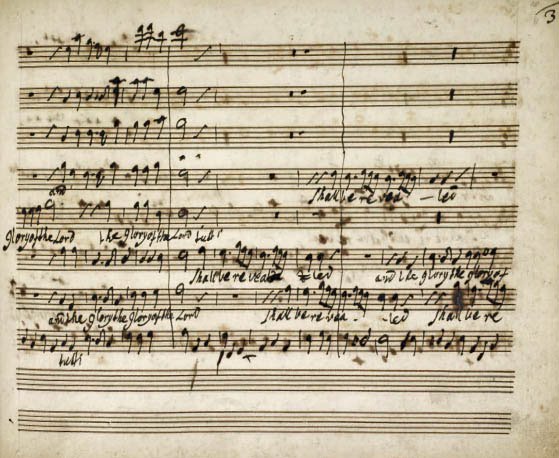 Almost exhausted after the literary collection, the Library also has a Magna Carta (actually they have quite a few), a wall full of ancient maps revealing the developing exploration of the planet, original scores from musical giants such as Mozart, Beethoven and Bach (along with Handel’s Messiah, shown right) through to some handwritten lyrics from The Beatles and a collection of major scientific works including efforts from such luminaries as Galileo, Newton, Leonardo Da Vinci, Harvey and Darwin.
Viewing all these treasures, I couldn’t help but wonder how the next thousand years will be represented. With almost nothing being handwritten and words being penned by a mix of word processors and spell-checkers, it is difficult to imagine the British Library’s Treasures of the Second Millennium would generate the same awe and wonder as the last - the painstaking work and artistry of the early texts, the remarkable formation of the language from a flurry of foreign tongues and the celebrated texts of famous authors through the ages.
Saying that, the English language continues to expand and enrich while languages only spoken in small pockets of the world are starting to be lost. The journey of the first thousand years is richly covered by the remarkable British Library, the treasures being the smallest fraction (though extensive enough) of the 150 million items (including 14 million books) and 300 kilometres of shelving in its extensive collection. What will the next thousand years bring the language and the library?
What would expect to see over the next thousand years for our language?
Note: All works shown are by courtesy of the British Library. Their extensive website includes an English language literature timeline.

Friday, October 1, 2010
Drinks Around the World: Chocolate Mocha Martini (Hotel Chocolat, Cambridge, England)

guest drink around the world article by Hotel Chocolat, which I can recommend for their superb chocolates.
The ancient university city of Cambridge lies fifty miles northeast of London, surrounded by the low-lying farmland of East Anglia. It’s small and picturesque car-free city centre – where cafes and shops sit amongst ancient university buildings and narrow cobbled lanes – is perfect for a walking tour of the sights.
On clear autumnal afternoons in Cambridge a light mist settles on the River Cam, and weak wintry sunlight bathes the crisp brown leaves littering the perfect lawns of the historic university colleges. In this season of shortening daylight, red cheeks and wrapped-up scarves; warmth, comfort and indulgence are craved. All these can be found in this sumptuous cocktail recipe from Hotel Chocolat – a British luxury chocolatier and cocoa grower, based in a town close to beautiful Cambridge.
To make this unusual gourmet chocolate cocktail, you’ll need a bar spoon or similar, a mixing glass, a chilled Martini glass and strainers. Take a high quality double espresso shot, around 50mls of hot coffee, melt in two bar spoons of Hotel Chocolat Liquid Chocolat – 100% Cocoa and stir together to make an excellent high quality mocha.
Pour this into a mixing glass; add 2 shots (50ml) of vanilla vodka, and half a shot of gomme syrup to sweeten the rich dark chocolate and coffee flavours a touch.
Top off the mixing glass with ice and mix well in a shaker, then double strain into a chilled martini glass. Garnish with a sprinkle of the delicious liquid chocolate powder and sink into an armchair by the nearest log fire.
Check out a video showing a Chocolat Mocha Martini being made.
This is a real winter warmer of a cocktail that mixes the rich bitterness of coffee and fine cocoa with the smooth sweet flavour of vanilla vodka. Hotel Chocolat is the only British chocolatier to own their own cocoa-growing estate, found on the Caribbean island of St Lucia. Further inspiration for cocktail recipes and other gourmet chocolate cuisine can be found on their website along with a wealth of information on fine single estate cocoa for the discerning chocoholic.
Wednesday, August 5, 2009
Naval Riches (Portsmouth, England)

The historic dockyard in the Royal Naval Base of Portsmouth is a treasure trove of British naval history throughout the centuries. In the one area, the Mary Rose from the mid-1500s, Admiral Nelson’s famous HMS Victory from the late-1700s and Britain’s first iron-armoured battleship, HMS Warrior from 1860 stand proud from the era where naval power was a passport to military dominance. A combined ticket offers good value to see all three ships along with a handful of museums. From the seafaring figurehead at the front of the ship, elegant yellow and black paintwork, the network of rigging on the masts and the superbly constructed (though smallish) admiral quarters encased in numerous windows at the stern of the ship, HMS Victory has a regal feel. The hull is constructed from two feet (60 centimetres) of solid oak.
By contrast, the cramped conditions with over 100 cannons and 800 men in a tight space must have made sea battles a hell on water. Utilising every inch of space, the men’s hammocks swayed over the cannons while even the dining tables hung from ropes. People of even average height today need to duck to avoid striking their heads on the beams below decks. With the pride of victory at Britain’s most famous sea battle at Trafalgar, HMS Victory remains in commission as the navy’s oldest ship. A plaque marks the location where Nelson was shot in the shoulder by a French musket ball. He died below decks three hours later, victory having being secured, supposedly uttering the words “Kiss me, Hardy” to the ship’s captain. On 21 October every year to commemorate the Battle of Trafalgar, marine flags representing Nelson’s famous expression “England expects that every man will do his duty" are hoisted.
Remarkably, one of HMS Victory’s large sails (around 25 metres by 15 metres), scarred with an estimated 90 shots from the French navy in the Battle of Trafalgar is on display in a special separate room. Nearby is the Mary Rose, or more accurately a cross-section of it. Having capsized and sunk in 1545, King Henry VIII’s flagship lay on the seabed until she was retrieved in 1982, the portion that lay above the seabed having being consumed by marine woodworms. Today she sits in a ghostly mist of glycol behind Perspex windows, using the same longwinded but successful preservation method as the Swedish Vasa. A staggering number of artefacts are displayed nearby.
 HMS Warrior reveals the life of a seaman in Queen Victoria’s time. This giant iron-hulled warship, replete with both steam power and sails never fought a battle. Her mere foreboding presence, power and heavy armory supposedly deterred all enemies. Again the starkness of the living conditions between the senior officers and the seamen and the cramped living conditions are visually striking.
Though a dull town, the harbour is a flourishing centre of activity with modern naval craft competing for space with the hordes of ferries heading for the neighbouring Isle of Wight or the European mainland. Portsmouth dockyards are a travel wonder making a wonderful day reliving naval history through three well-displayed and exceptional ships of their day giving a small sense of the harsh lives that the seafarers lived, especially in battle.
Other British and Irish Posts
All the World's a Stage (Stratford-upon-Avon)
Soaking Up Culture (Bath)
The Illuminated Manuscript (Dublin, Ireland)
A Bit of British (Gibraltar)
Photo Source: Mary Rose
Thursday, June 4, 2009
All the World’s a Stage (Stratford-Upon-Avon, England)

If John and Mary Shakespeare had not borne a son, William, who proved to be the world’s finest English language writer and playwright of all time, then it is doubtful whether the travel wonder of Stratford would have progressed beyond a pleasant English market town. Rather, people gather in their hordes to make a literary pilgrimage to Stratford-upon-Avon and “The Bard”. Stratford has captured and preserved aspects of the city centre around the early 1600s, especially anything remotely related to the writer and his family.  Doing a circular walk around town (the information centre has suggested walking tours marked on street maps), you can pass most of the major aspects of Shakespeare in time order starting at his half-timbered birthplace, containing an excellent museum detailing the shreds of understanding of Shakespeare’s life. Past Nash’s House, where the writer’s granddaughter lived, the grammar school (where Shakespeare likely schooled, though no-one seems to know for sure), another Shakespeare’s house and you’ll find the stately Hall’s Croft.
  This elegant medieval mansion was the home of Shakespeare’s eldest daughter and her doctor husband. It hosts a creaky period feel with an intriguing display on the medicines of the time and a strong encouragement to stay healthy in those times.
Notably, High Street briefly escapes the Shakespeare-mania and is lined with well-preserved Elizabethan half-timbered houses from Shakespeare’s time with their low ceiling beams. Except for the cars, a bit of imagination could take you back to those times with the hubbub of people wandering to and from market for their daily needs.  Walking towards the Avon River, the Holy Trinity Church is the last resting place of William Shakespeare. Lit by fine stained glass windows and laying next to his wife in this stately honeycomb-coloured church, Shakespeare’s simple grave is marked by a curse in verse and a fear of being dug up:
Good Frend For Iesus Sake Forbeare,
To Digg The Dvst Encloased Heare.
Bleste Be Ye Man Yt Spares Thes Stones,
And Cvrst Be He Yt Moves My Bones. Along the same river are the main theatres including the Royal Shakespeare and the Swan, the latter being modelled on Shakespeare’s original Globe Theatre. Different plays were on different nights when I was there and are well worth experiencing to complete the Shakespeare experience (though tickets were difficult to get). In sunny weather, punting along the Avon is a popular pastime and shows the town at its best.
A kilometer west of the town along a marked footpath is the steeply-roofed thatched farmhouse of Anne Hathaway (top photo). With a resplendent flower garden, trimmed hedges and superb wood-carved four-poster bed, this is the most photogenic of the Shakespeare houses.
Stratford-upon-Avon has strained every thread of detail about William Shakespeare’s poorly documented life, preserving the half-timbered houses of the time. If The Bard isn’t your thing, there are any number other English town that have richer histories, better sights and are less crowded. But if your school studies sparked even an interest in our most famous playwright, then Stratford is for you and a chance to reacquaint yourself with a play that you studied some years ago. And while you are there, head another ten kilometres north and visit the travel wonder of Warwick with its immense castle and impressive church.
Other British and Irish Posts
Soaking Up Culture (Bath)
The Illuminated Manuscript (Dublin, Ireland)
A Bit of British (Gibraltar)
Jacob's Ladder (Cheddar)
Half-Timbered Houses (Lavenham)
Monday, April 6, 2009
Photo of the Week - Jacob's Ladder (Cheddar, England)
 Cheddar is a village in the south-west of England in an area threaded with deep gorges. This popular travel wonder is famous for being the original home for a tasty hard cheese and for its limestone caves.
The unremarkable photo is part of Jacob’s Ladder (named after the stairway to heaven), an ordinary set of 274 concrete steps through light forest, which take visitors from the gorge floor to a view over the expanse of county Somerset. To give an idea of the huge passage of time, it gets visitors to imagine that each step represents one million years. On that basis, the dinosaurs roamed the Earth for around 160 steps, dying out about 65 stairs ago while the caves were carved by flowing waters over a comparatively recent single stair.
All of human history is represented by a single sheet of paper resting on the very top step of this calf-burning climb. Makes you think about the fleeting nature of life.
Other British and Irish Posts
Soaking Up Culture (Bath)
A Bit of British (Gibraltar)
The Illuminated Manuscript (Dublin, Ireland)
Half-Timbered Houses (Lavenham)
Sunday, February 15, 2009
Photo of the Week - Half-Timbered Houses (Lavenham, England)
 Lavenham is a delightful old English village with a disproportionately large church and delicately balanced medieval half-timbered houses. It looks as if a strong breeze could blow these ones over, though they've probably been there for 400 or 500 years. Ironically, the leaning house was the office of the local real estate agency when I took this photo!
One of the regulars at the local bar jocularly claimed that Twinkle Twinkle Little Star was originally written in Lavenham and offered to sing it. The frowns and stark expressions around me suggested I refuse the offer and it was clear that he'd already enjoyed a few pints. Who knows if he was correct but it is something that I've never forgotten.
Other Photos of the Week
Stave Church (Norway)
Remote Sign (Iceland)
Bad Hair Day
The Asymmetric Chapel (France)
Friday, November 14, 2008
Soaking Up Culture (Bath, England)
 Graced with timeless Georgian architecture with its focus on perfect symmetry and simple elegance and coupled with a world famous Roman spa, Bath is surely one of England’s greatest travel wonders. On discovering natural hot springs, the ancient Romans built baths and associated therapeutic qualities to the mineral-rich waters. They dedicated the site to Minerva, the goddess of wisdom.
As the Roman Empire failed, the springs were forgotten until the spa town was reinvigorated with the royal patronage of Queen Anne. Refined buildings were erected to house the stately and prosperous folks of the day. The Royal Crescent is a superb semi-circular honeycomb-coloured limestone building of thirty houses with a lush lawn as frontage.
 Equally superb is The Circus, a masterpiece which forms a complete circle cut into three equal segments by roads which lead into the complex. All roads face straight onto one of the segments. Inspired by the Roman colosseum, the three storeys showcase three classical columns – Doric, Ionic and Corinthian. Many famous people have called The Circus their home including William Pitt (ex-Prime Minister), the painter Thomas Gainsborough and African explorer, David Livingstone.
The Pulteney Bridge remains as one of only four bridges in the world with shops across the entire bridge. Spanning the Avon River, near a small cascade, it is built in the style of Ponte Vecchio in Florence. To build an element of relaxed and refined living, the city forefathers planned parklands to run alongside much of the Avon River in Bath, encouraging people to stroll the river banks or sit and enjoy the city’s charm. Nearby Bath Abbey with its huge vaulted ceilings has a point of significance for Australians. It is the memorial to Arthur Phillip, the first governor of the colony of New South Wales on European settlement in Australia in 1788. Similarly, a memorial to Isaac Pitman who invented shorthand is in the abbey.
However, the Roman Baths are undoubtedly the highlight of Bath. Built below today’s city level, the view from the terrace offers the first view over the baths. The most inspiring element of the baths is the advanced engineering used by the Romans to manage the water flow and control the heating.  Hot, warm and cold baths were all built within the public bathing complex. The sacred spring can be seen through the steam within the complex along with the orange-coloured deposits from the rich mineral content.
If you wish to test the medicinal qualities of the water, a sample can be drunk from the running fountain in the elegant glass-domed Grand Pump Room next door to the Roman Baths. It is my favourite English city with its relaxed elegance and a treasure trove of travel wonders. Sip the waters, stroll the relaxed streets, enjoy the striking Georgian architecture and be astounded by the ingenuity of the ancient engineers in the remarkably intact Roman Baths.