Throughout history, large walls surrounded many cities to protect their citizens and leaders from siege and attack. Sadly, most of these city walls have gone either torn down by attackers, removed by cities to allow expansion or simply taken apart to provide building materials for more useful buildings.
Spain has an impressive number of cities whose complete (or near-complete) city walls (or muralla) are so significant, well preserved and impressive that they merit UNESCO World Heritage listing. All are rich in history with four of the five can be easily visited as day trips from Madrid.
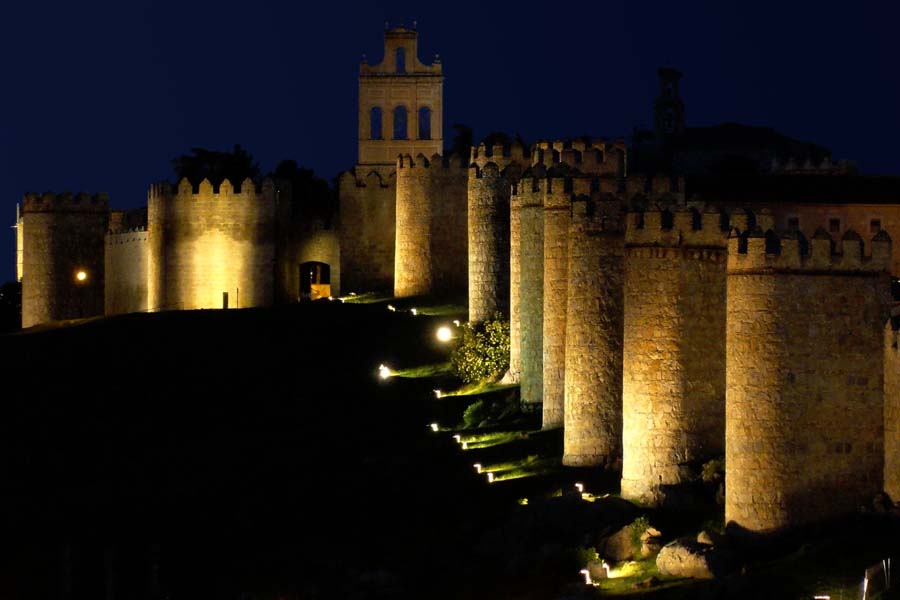
Ávila (Avila) Not that far from Madrid, the city of Ávila is impressively located perched on a high plain that rears sharply from the arid treeless surrounds. With a domination of churches, monasteries, convents and basilicas under the name of the ascetic Saint Teresa (whose mummified hands are in one of the churches), the pious city was subjected to battles for centuries between the Muslims and the Christians. The 12th century construction of 2.5 kilometres of superbly maintained walls, 88 towers and 9 gates eased the battles and today the exterior makes for a superb walk. At night the elegant crenellations add a regal imposing look to the city while three parts of the walls can be walked for a closer look.
Segovia Near Ávila, Segovia is an enchanting small honey-coloured city strategically perched on a rocky outcrop and encased in an 11th century wall. With history dripping around every corner of its narrow lanes, its undoubted highlights include a towering double-arched Roman aqueduct that cuts through the city, a cavernous cathedral and the fairytale Alcazar (and the world’s oldest existing industrial plant with the 1583 Mint). The Alcazar is an evocative 900 year old royal palace that emerges majestically from a rocky crag, its long narrow shape, sheer sides and witches-hat roofs being the inspiration for Sleeping Beauty’s residence.
Toledo Immortalised by El Greco and a former capital city, Toledo is a treasure trove of medieval buildings and cultural sights. Dating back to Roman times and ideally sited for fortification with a loop in the river protecting three sides and two imposing walls protecting the fourth, the city is jam-packed in a maze of streets with places of worship for Christians, Jews and Muslims, highlighting its wars and battles over past centuries. Toledo makes for a superb one day trip from Madrid walking the labyrinthine laneways soaking the medieval charm of so many historic structures.
Cuenca Just east of Madrid and encased by deep gorges on three sides, Cuenca was purpose built for fortification. More famous than its city walls are its exceptional hanging houses (las casas colgadas) grimly clinging to the cliff sides, their balconies protruding into fresh air and highly unsuited for those uncomfortable with heights. One excellent example now serves as the Abstract Arts Museum.
Lugo In the very north-west of Spain and surrounded by over two kilometres of Roman walls built in the third and fourth centuries (yes, over 1700 years old), it is the only complete Roman wall anywhere in the world. With the wall being six metres thick and with a twenty metre wide moat around the walls, Lugo was near impregnable. Eighty-five towers rise out of the wall giving vantage points in every direction to give the city warning of any pending attack.
While there are a number of examples of walled cities throughout Europe, north Africa and Asia, Spain has an impressive concentration of them, each making for a superb one-day visit. Other Spanish cities including Girona and Badajoz also boast well preserved city walls. While all the cities have sprawled well beyond their medieval bounds, it is a chance to imagine the importance that these walls bought in protecting the city and the efforts that leaders went to maintain the city against the constant threat of attack.
Photo Credits: Avila Night, Avila Walls, Toledo, Cuenca, Lugo
Sunday, October 30, 2011
The Walled Cities of Spain


Thursday, September 8, 2011
Escape the Crowds in Barcelona (Spain)
 guest post by Thomas Lukjaniec
Countless numbers of tourists flock to Barcelona each year to catch a glimpse of world famous sights and landmarks such as the Sagrada Familia, Las Ramblas and the Camp Nou. This often leads to swarms of tourists clogging up the city centre (especially during the summer months) and ignoring the many wonderful things there are to see and do that are just a stone’s throw away from the Catalan capital. So, if you’re planning a trip to Barcelona, or if you’re already there, then here are five worthwhile ways to escape the crowds.
Montserrat This breathtaking mountain is situated just an hour so away from Barcelona and is a must see for all those travelling to the city. It proudly boasts UNESCO World Heritage Site status and rises majestically to 1235m above sea level boasting panoramic views of the surrounding terrain. However, the main attraction is the mysterious formation of rocks found here and the beautiful Royal Basilica. Tours to the mountain are available all year round.
Sitges
Sitges (top photo) is where locals go to unwind on their days off - a strong recommendation indeed. It is the perfect place to escape the tourist infested beaches of Barcelona. This charming little town is situated just 40km outside of the city and is easily accessible by train. It’s well known as an historic centre with beautiful beaches, a peaceful ambiance and a thriving gay community. It is a true jewel of the coast and is ideal for families and friends to spend a fun and relaxing afternoon.
Illa Fantasia This water park is located just a 45min drive from Barcelona city centre and makes for a great way to cool down from the sweltering heat during the warmer months of the year. With lots of wet and windy slides, picnic areas and eateries, a trip here is ideal for families, couples and groups of friends looking for a fun day out. Julia Travel will get you entrance, as well as travel to and from the park, at a very reasonable price!
Hot Air Balloon Tear yourself away from the sights of Barcelona for one day and treat yourself to something unusual by taking a ride in a hot air balloon. Take in unrivalled views of the city from above and enjoy an experience that is truly unforgettable.
Barcelona Cruises
Taking a cruise from Barcelona is the ultimate way to see the city before setting sail on to other stunning Mediterranean destinations. Another excellent option is catching a ferry to one of the nearby Balearic Islands (Mallorca, Menorca and Ibiza), which offer one of either the perfect party or peaceful getaway from the city.
So there you have it - five fantastic ideas to escape the tourist crowds in Barcelona! All that’s left is organising accommodation for your stay in the city. It’s a good idea to base yourself centrally, where the fantastic transport system will allow you to reach all of these destinations with ease. Renting apartments in Barcelona is often a popular choice amongst visitors and will allow you to live close to these transport links, thus leaving you free to explore all of these wonderful places at your convenience.
Photo Credits: sitges, basilica, water park, balloon
Tuesday, August 16, 2011
Ibiza - Beyond Clubber Paradise (Spain)

guest post by Mohamed Khazma
Dazzling away in the Mediterranean sun, the island of Ibiza is home to hedonists. Four months in a year Ibiza is turned into a clubber's paradise, it holds its status to date as the world's best clubbing destination. Trapping the biggest parties in the world into one location is a virtue of insanity, but it somehow manages to keep order and sustain its worldwide reputation.
Ibiza, however is far from just a playground of booze and music, it still to this day holds its own historical significance and reputation for a beach / adventure like destination to match the rest of the Mediterranean islands.
Summer Adventures
By day, the thousands of clubbers visiting the island will try and find a cure from the previous night and ready their adrenaline for the next night of boozing. Ibiza’s countless and sublime clear water beaches are just one cure, with this setting, the beaches provide a platform to allow access for diving, windsurfing, sailing, jet skiing, parachute sailing, banana rides and boat rentals – to name some.
 Past Ibiza’s clichéd beach activities, the Jeep safaris provide visitors with a rugged discovery of the islands most secluded landscapes and pristine coastlines. Mountain biking is the adrenaline junkies alternative, providing a free roam platform to discover Ibiza’s true country paths, the tours start from the west coast through the hills of San Agustin; the east coast trail visiting the charming village of San Carlos and the tower of Pou d'es Lleo; and lastly a trail through Ses Salines Natural Park, to roam in its dunes and ponds.
An Alternative Summer
 Located in Puerto San Miguel is the biggest cave in Ibiza. Cova de Can Marçà, an estimated 100,000 years old limestone cave is spectacularly lit by coloured lighting, together with an artificial waterfall – creating an almost unreal setting. Bounded by breathtaking sea-views, visitors enter the rocky inlet of stairs allowing the discovery of its underground stalactites and stalagmites, and lakes through multilingual guided tours.
With every island comes a mystery, when a landmark doesn't appear on maps, nor is it signposted from any nearby road or path – it is sure to be sought after. Atlantis, an old quarry island off the coast of Ibiza is seen by most locals as Ibiza’s spiritual Mecca (top photo). Atlantis leaves behind the remains of sculptured rocks from the stonecutters who used it as a source for raw material to fortify mainland Ibiza. The quarry is accessible via a short boat ride.
Winter in Ibiza
 The clubs have locked-up, streets cleaned, beaches abandoned and the airport is at its quietest in the year. Ibiza’s white canvas is turned into vibrant flora, what remains is a well-kept secret creating the most tranquil time of year for Ibiza’s residents and the few discerning holiday makers.
One of the most unique experiences in Ibiza is horseback riding in the northern mountainous landscapes. Rising though Ibiza’s natural protected areas, encompassing wildly romantic scenery and overlooking the islands coastline, it is an indulgent adventure for the winter season. The tours start from a few hour rides, to a full week package including agro-tourism hotels, charming, yet small, but a far-cry from the monstrous tourist hotels in Ibiza’s main towns.
Deserted beaches can come rarely on such an island, even with Ibiza’s 300 day sunshine a year, winter season in Ibiza sees no sunbeds, nor masses of crowds to spoil the view. The water pulls in gently at shore, the lush vegetation rustling, birds singing, and the entire beach open for an invitation of seclusion. Strolling slowly along the sandy promenade, soaking up the sun and replenishing the winter sunshine – Ibiza paints the perfect winter like paradise for some.
Photo Credits: atlantis, remote road, cave, ocean

Tuesday, August 9, 2011
A Ramble Through Las Ramblas (Barcelona, Spain)

by Emily Collins
The 1.2 kilometre Las Ramblas is the most famous street in Barcelona, and in particular the south contains some of the city’s most unique tourist attractions. Many people don’t realise that this tree-lined boulevard is actually made up of five inter-connected streets, which stretch all the way up from the marina at Port Vell to Placa Catalunya in the northern end. The street features live performers, street theatre and human statues, which makes the street extremely popular with tourists. The Ciutat Vella area in particular features a number of popular Barcelona hotels that backpackers and young tourists flock to because of the central location and close access to some of the city’s best bars and nightclubs. But Las Ramblas has more to offer than just great evening entertainment, there is so much to experience along this famous street including these places of interest.
Wax Museum
 Museu de Cera or the Wax Museum is Barcelona’s answer to Madame Tussauds, but don’t expect to pose for faux photos with B-list celebrities. This museum takes you back in time to meet some of history’s most prominent figures and figurines. As well as Spain’s very own Christopher Columbus, you’ll meet kings, queens and people of great nobility. There’s even an area which traces back the origin of some of Spain’s most important traditions such as flamenco and cantaor dance – it’s one place the whole family will enjoy.
Erotica Museum
 Now for an attraction that’s strictly adult’s only! The Erotica Museum at 96 Ramblas is often filled with groups of giggling tourists but in fact it’s a fascinating glimpse into the lesser seen side of history. Sure, it might feature some strange apparatus – but what it’s really known for is its wide collection of art. Featuring collections that range from 19th century Hindu art and Victorian postcards to modern contemporary art and Spanish cinema it’s definitely one to visit with an open mind.
Christopher Columbus Monument
 The Christopher Columbus monument can be found at the southern end of Las Ramblas and acts as a testament to Spain’s greatest explorer. The monument reaches 60 metres into the sky and a statue of Columbus can clearly be seen gracing the top. If you turn off Las Ramblas at this point, you’ll reach Port Vell where the aquarium and IMAX cinema can be found. This area is also near to Barceloneta Beach – which was recently named the best urban beach in the world. It is certainly one of the best beaches in the Costa Brava region; the area of Spain to which Barcelona belongs. And many fantastic Costa Brava hotels can be found bordering its sandy shores, such as the H10 Montcada Hotel which boasts its own sunset terrace.
Joan Miro Artwork
 Gaudi’s artwork can be seen all over Spain but few people are aware that they can also see the work of Joan Miro in the city. Miro’s famous tile mosaic is located right in the centre of Las Ramblas next to Liceu Theatre. The circular swirling pattern is automatically recognisable as classic Miro style, but just in case, if you look carefully you’ll find that one of the tiles in the piece bears the artist’s signature.
La Boqueria
Barcelona’s most famous market is located on Las Ramblas and you’ll find that this is a fantastic place to stop for lunch, particularly if you’re on a budget. Even in an expensive city like Barcelona you’ll find that you can eat out here for next to nothing. Try El Quim, a family run stall in the middle of the middle of the market for the best tapas in town. Alternatively you could pick some up traditional cured meats, chorizo and bread and take a picnic in the nearby Jardins de Victoria de Los Angeles.
Photo Credits: human statue, wax model, Miro

Thursday, July 14, 2011
Tenerife for Thrillseekers (Spain)

guest post by Amy Baker Aspiring Tiger Woods’ may be unable to think of anything better than a holiday chock a block full of Tenerife golf but what does the island offer for those who like something a little more adrenaline fuelled? Well, this volcanic Canary Island is just the spot for a multitude of activities designed to get those pulses racing and year round sunshine guarantees that it will always be a pleasurable experience.
Whether you are a beginner or a seasoned surfer there are numerous beaches dotted around the island that are perfect for all abilities and that aren’t too far from the famous Tenerife bars which ensure a raucous evening is had by all.
Great surfing spots include El Socorro in the north of the island where there are consistently good waves and despite its name, Los Gigantes beach doesn’t always have waves big enough to send even Kelly Slater running for the hills in fear, in fact this is a great spot for beginners and it is easily accessible by car. El Medano is another good beginners beach but is perhaps better known for windsurfing and kite-surfing allowing you to turn up and figure out which activity you fancy having a go at that day. Rock climbing is big business in Tenerife due to the warm climate and some of the most challenging climbing in Europe. There are over 900 different routes to explore ensuring that beginners and advanced climbers are catered for.
Arico Gorge is the largest climbing area on the island and is home to the most challenging routes. Arico is a dried up riverbed full of huge boulders, pine trees and crazy overhangs up to 30m high. Certainly not for the faint-hearted! Another great spot is Cañada del Capricho at the base of Mount Teide where there are spirals of volcanic rock up to 300m high to tackle. The only problem with rock climbing holidays is that you need to lug your equipment around – adventure travellers have gotten around this by taking up new craze – bouldering. There are eight good bouldering sites where all you need is your upper body strength and a crash mat and you’re away.
Lazing on one of Tenerife’s beaches may be sufficient entertainment to some but more adventurous tourists may opt for only visiting the beach as they come in to land from a skydive. There are a multitude of skydiving schools to choose from all offering you the chance to go against all your body’s natural instincts and fling yourself out of a plane. If that’s not for you then paragliding is another popular activity in Tenerife and rewards adventurers with a slightly more relaxed birds eye view of the island. The islands unbeatable weather guarantees warm thermal currents perfect for paragliding.
No matter what activity you are a fan of or would like to try, Tenerife is bursting with options which will allow you to enjoy the glorious year-round sunshine whilst working up an appetite which means you will be able to put away a few beers and some hearty Canarian fare without any guilt. For more information about the activities offered on the island visit mydestination.com/Tenerife.
Photo Credits: sunrise, rock climbing, paragliding
Amy Baker lives in London and works as a freelance writer and editor for a variety of magazines and online media. She enjoys a good book, photography, eating out, getting to know new people and places and aims to travel the World.
Sunday, May 29, 2011
Destination Review for the Canary Islands (Spain)

guest post by Airtours The Canary Islands have long been associated with all inclusive holidays. Tripadvisor.com has recently voted the Canaries as having six out of ten of the best beaches in the whole of Spain. However, there is far more to the archipelago than just glorious temperatures, crystal clear waters and powder soft sand.
Canary Islands Overview
The Canary Islands are group of Spanish islands situated just off the north coast of Africa. Because of their location they are subject to equatorial weather conditions, which gives them the added advantage of almost guaranteed sunshine 365 days a year. They have a long and complex history, with evidence of Neolithic settlements across the islands. The Canaries have also been visited or invaded by a number of races including the Phoenicians, Carthaginians, Europeans, Arabs and Portuguese. Each invader has left remnants of their culture behind, reflected in the eclectic cuisine, architecture and numerous festivals of the islands today. For those looking to incorporate a natural angle into their sun holidays, the Canary Islands are filled with fascinating and unusual wildlife, both on and below the land. There are four national parks, two of which have been declared World Heritage Sites by UNESCO. The other two are recognised as World Biosphere Sites, reflecting their ecological importance. These are regularly visited by tourists on nature trek holidays, where they can see over 600 endemic species of flowers, birds such as the Blue Chaffinch (photo) and Tenerife Ringlet and animals including geckos and the El Hierro Giant Lizard.
 Below the waterline, the variety of life is even more spectacular. The seas surrounding the once-volcanic islands play host to a multitude of vibrant and colourful creatures such as Leatherback turtles, starfish, sea anemones and a breathtaking array of fish. Many visitors enrol in the local scuba schools so they can experience the marine life in its natural environment.
Attractions
In addition to the Islands’ natural splendour, the Canary Islands are well served for holidays of all types. There are seven islands, each with its own unique character. Golf is a popular pursuit across all of the islands and there are over 20 world class courses to challenge even the most dedicated player. With the islands being so well served by the ocean, it is small wonder that the PWA World Windsurfing Championships are held here, and the Lanzarote Volcano Triathlon sees competitors swimming five kilometres as part of their trial.
Visitors looking to soak up some culture will enjoy other aspects of Canarian life such as the Tenerife Gastronomy Fair or the Gran Canaria Opera Festival. While the Canaries are synonymous with a hedonistic party scene, this tends to be only on certain areas of certain islands. While revellers flock to areas of Tenerife and Lanzarote, families and those looking for peace and quiet can remain undisturbed on the same islands, albeit in different areas. Families will have no problem with entertaining younger visitors. In addition to the beaches, water sports and wildlife reserves, there are a variety of theme parks such as Tenerife’s water kingdom, Siam Park, and Aqualand in Maspalomas.
The Canary Islands are as rich and diverse in what they have to offer as they are in the bounty of wildlife and stunning panoramas. Sun is an integral part of any holiday, but it doesn’t have to be the deciding factor, especially when there is so much more to discover.
Photo Credits: sunset, blue chaffinch, turtle
Saturday, May 21, 2011
Dip into Some Delicious Spanish Delicacies!

guest post by Amanda Hattersburg
Spain's popularity as a holiday destination means there are many attractive Spain holiday deals to choose from, whether you’re looking to indulge in some scintillating time in the sun or view the architecture that has made it such a fascinating tourist attraction.
But despite the diverse range of activities across the country, there is one thing holiday-makers universally appreciate about Spanish culture... its cuisine!
There are so many different dishes to indulge in – most are relative to their region – offering different depths and dimensions to their respective areas. Here are some favourites, and where they can be found.
Cocido A dish totally in tune with both Spanish and Portuguese culture, cocido is a classic regional stew made from meats, vegetables, sausages and either chickpeas or garbanzo beans. The most famous cocido lies in Madrid, and is called the cocido madrilène. Translated as ‘Madrid stew’, it’s heavy on the meat and typically contains salt pork, beef, ham, chorizo, a stewing chicken, morcilla and a vegetable and potato mix.
Gazpacho A very popular dish consumed widely across Spain, gazpacho is a raw tomato and vegetable-based soup. Originating from Andalusia in the south of Spain, gazpacho is the perfect way to cool down on a hot summer’s day. Served cold, gazpacho soup is distinct because of its bright red colour, though replacing the tomatoes with other ingredients such as watermelon, avocados or seafood can make a difference and offer real variety, both in colour and flavour.
Paella You’d be forgiven for thinking that paella is Spain’s national dish, such is the delicacy’s reach across the globe. But, in Spain, paella is regional to Valencia and regarded as something of a local speciality. There are three different types of paella to sample when visiting Spain: Valencian paella, mixed paella and seafood paella. No matter which paella you try though, watching its preparation is mastery itself. According to tradition, paella is supposed to be cooked over an open fire by men, which has to be kindled with oranges, pine cones and pine branches for aroma before being eaten directly from the pan.
The Spanish Mediterranean diet also consists of a lot of seafood - fish such as hake, squid, shellfish, traditional fried fish dishes and more besides. The Spanish culture and available cuisine across its many regions is a delight to explore and discover day after day, and something that has to be truly experienced first-hand.
Photo Credits: food, cocido, gazpacho
Sunday, April 24, 2011
The Alcazar of Seville (Spain) - A Historical Survivor

guest post (and photography) from Sandra Vallaure, editor of Seville Traveller, a website providing useful information on Seville for independent travellers
Seville is the most beautiful city in Spain. Actually, Spaniards often compare it to a woman and always define it as elegant, majestic and gorgeous. Additionally, it was one of the first Spanish cities founded by the Romans. As you can imagine, History has left its trace in Seville. As a result, the city is a combination of impressive monuments and narrow streets where you can wander as long as your feet permit it.
Among all the monuments Seville has, one stands out: the Alcazar.
The Alcazar is, together with the Cathedral and its bell tower, the Giralda, one of the main symbols of the city.
A little bit of history The area was initially occupied by the Romans and of the first Christian basilicas was built there. However, it not until the Arab occupation (844-1248) that the Alcazar was built, or at least part of it. When the Arabs finally conquered the city, they decided to create a structure for the governor that would be both a palace and a fortress. In fact, the Spanish word alcazar comes from the Arab al qsar that means palace, castle or fortress.
The Alcazar had the usual Arab architecture, and it was full of beautiful patios surrounded by thin columns supporting horseshoe arches. With the arrival and reconquest of the Christians leaded by King Ferdinand III, the Alcazar became the Royal Palace. From there on, the following kings ordered to perform alterations to adequate the complex to their needs and added further pavilions and structures.
Consequently, the Alcazar evolved into a unique place where you can find -and will actually see if you happen to visit it, a melting pot of Arab, Medieval, Renaissance and Baroque styles.
The Alcazar has been inhabited by most of the main kings and queens of Spanish history: Ferdinand III himself, the Catholic Monarchs, Charles V and many more. Even today, the King Juan Carlos I occupies the Alcazar when he is in Seville.
Don't miss...
I particularly recommend to pay attention to the Ambassador's Hall (Salón de los Embajadores) located inside Don Pedro's palace, also known as Palacio Mudéjar. Every little detail has been taken care of and the ceramics are absolutely spectacular.
Moreover, spend some time at the Maidens' Courtyard (Patio de las Doncellas). It has been recently restored and it is one of the finest examples of an Arab patio that can be found in Seville and, I dare to say, Spain. Finally, don't miss the gardens. They are magnificent. In truth there is not only one big garden but multiple small ones, every one with a different style and plants. There is even a labyrinth!
The smell of the orange trees, spread everywhere and the sound of the water flowing at the various fountains will charm you. I believe that one of the highlights of the Alcazar is to seat for a while and relax while observing all this nature surrounding you.
The Alcazar is an architectural masterpiece that explains on itself a large period of the history of Spain and Seville. On top of it, it is one of the finest examples of the Arab style of the 10th century. Sometimes how, after earthquakes, wars and fires, it has managed to survive.
So why not going to Seville during your next holiday? You will have the opportunity to enjoy one of the nicest European climates while devoting your time to discover wonders like the Alcazar.
Are you planning to visit the Alcazar? Have you done so already? Share with us your experience in the comments below!
Tuesday, February 15, 2011
Marbella after Dark (Spain)

guest post by Roberta Summer of MyDestinationInfo.com, your local travel guide to worldwide destinations. Spain’s Costa del Sol is known for its sunshine, sandy beaches and carefree fly and flop getaways. Both Spaniards and foreigners alike flock here for sun kissed breaks where days can be spent chilling out by the sea or unwinding by one of the many hotel pools dotted around the area.
There is of course another reason that has helped to cement the Costa del Sol’s popularity - its buzzing nightlife. With the balmy Mediterranean temperatures extending from the daytime well into the evening, the regions bars, restaurants pubs and clubs have thrived. None more so than in the chic, coastal resort of Marbella
Marbella’s reputation as a playground for those who like to see and be seen is riding high. Rich celebrities and trendy young things who enjoy flashing the cash come here to unwind and party. However, if you don’t have the bank balance to rival Simon Cowell it is possible to come and get a slice of the action without incurring credit card melt-down. The clubs of Marbella include some of the best in the world with international DJ’s, opulent venues and celeb sightings. If you do have money to spend there are plenty of venues to crack open the wallet. However, if you want a good night out without the price tag Dreamers in Puerto Banus is hard to beat. Get there before 11pm and entry’s free - although you will have to wait a bit for the party to really get started as clubs in Spain don’t tend to get going until 1am. But with a bar and sofas located on the top floor (with a dance floor on the level below) you can get some drinks in while you wait. DJ’s who have spun the discs here include Roger Sanchez, Bob Sinclair and Laurent Wolf - reason enough to get there early to reserve your spot on the dance floor…
Sonora Beach in Estepona is another budget-friendly option with a more laid-back vibe and beach front, bohemian ambience. Cocktails, food and music are first-class and if you like open-air venues you should definitely check it out. If you’re not into clubbing but still want somewhere to hang out with a drink in hand, beach bars are good options - and offer up the opportunity to chill out with a drink during the day. Along this stretch of Spain’s coast lies a range of sea front watering holes with Mistral Beach Club right near the chic resort of Puerto Banus a popular choice. As well as offering up drinks and sunbeds the bar has also teamed up with Hollywood Water sports, so you can get involved with a banana ride or two if relaxing with a cool drink becomes too much…
 Finally, if you want to get a more traditional flavour to your evening how about heading to a tapas bar? Here you can order a tipple and share a range of mouth-watering dishes like chorizo, patatas bravas, olives, jamón ibérico and calamares. Spaniards make a night of it by ordering a couple of tapas with their drink then moving onto the next venue - a fun way to see the resort, enjoy a drink, interact with the locals and of course try some of the local cuisine. Taking the traditional ‘pub-crawl’ to a whole new level…
Note: Read more on Marbella here.
Photo Credits: Sunset, cafe, Dreamers, Mistral Beach, calamares
Tuesday, February 1, 2011
Drinks Around the World: Horchata (Valencia, Spain)

Valencia and eastern Spain is famous for a traditional sweet milky drink called Horchata (or orxata de xufa in the local Catalan language). Originally introduced by the Moors around 1000 years ago, the drink is so popular that horchaterias, a kind of cafe, are in several of the Valencian towns.
Made from tigernuts (the tuberous roots of a kind of grass) mixed with water and sugar, and served icy cold, it looks like a milkshake and tastes of a very sweet non-dairy milk. Too sweet for my tastes, it is surprisingly refreshing. The highlight of the drink is that it is typically accompanied by tasty finger-shaped pastries called fartons that can optionally be coated in chocolate or filled with custard.
----------
Travel Wonders highlights a characteristic drink experienced on his travels. Prior articles have featured drinks as widely varied as Vietnamese slow-drip coffee, Austrian Almdudler, African zobo, Green Mint Tea from Morocco and cherry beer (Belgium).
Photo Credit: horchata
Thursday, November 4, 2010
Exploring the Big Four Canary Islands (Spain)

Guest post by Amanda Hattersburg. Amanda writes about everything travel related focussing on Canary Islands holidays. She writes frequently on travel subjects and enjoys publishing guest articles.
Despite being a set of seven distinct islands, much of the tourism in the Canaries is centred on four of the islands.
 Being the second largest of the Canary Islands, Fuerteventura boats a booming tourist economy. Although a quieter destination than other islands in the region, holiday makers are attracted by the wealth of opportunities for exploration here. The island is home to over 150 beaches and many archaeological sites: creating the perfect balance between exploring natural wonders and local history. The waters off the coast of the island are home to whales, dolphins, marlin and turtles; ensuring that underwater exploration is a must when visiting the island.
 Tenerife has often been heralded as the party island in the region but there is much on the island to entice those looking for a little more from their trip. Holiday makers are able to visit such natural wonders as the volcanic crater of Mount Teide (photo above)and the cliffs of Los Gigantes, whilst those looking for some historical and cultural exploration will find a visit to Puerto de la Cruz is a must.
 Individuals enjoying Canary Islands holidays will often wish to explore the natural habit of the island of Gran Canaria. The island has been described as a horticultural centre due to the countless plantations home to numerous species of plant and crop, but Gran Canaria also boasts huge sand dunes which can be explored to the full on the back of a camel. Not only are there countless natural features to the island but the bustling metropolis of Las Palmas enables tourists to explore the biggest city in the region. Las Palmas is home to various different local sports and at the right time of the year holiday makers can find the city in full swing during one of the many local festivals. This is the perfect time to explore the cultural heritage of this fascinating region.
 The remaining of the big four islands in the region, Lanzarote, provides holiday makers with possibly the most interesting landscape to explore. The entire island has been designated a UNESCO Biosphere Reserve due to the unique volcanic landscape which is found here. A trip to the Fire Mountains will enable visitors to fully experience the wonders of this inhospitable landscape as they will be guided through the area on the back of a dromedary and will witness the earth seethe in places despite the area being officially described as dormant.
Whichever of these four islands is the chosen destination there is huge scope to explore one of the most interesting areas of the world.