The striking clownfish became popular with the movie Finding Nemo. This curious tropical fish has one of nature's most remarkable symbiotic relationship with the poisonous sea anenome where it lives its life. Immune to the poison tentacles, it attracts other fish into the anenome's deadly lair, the clownfish able to feed off the remains of the prey. The clownfish additional cleans the anenome's tentacles.
The clownfish can alter its sex. Always born male, on the death of the dominant female, the primary male turns female.
How does such an elegant an attractive fish harbour such an intriguing lifestyle?
Sunday, February 13, 2011
Photo of the Week: The Weird Life of Nemo (Clownfish and Anenome)


Thursday, February 10, 2011
Prison Life on Alcatraz Island (San Francisco, USA)

'You are entitled to food, clothing, shelter and medical attention. Anything else you get is a privilege.' Initially a lighthouse and now a national park, the famous isolated prison on a rock sits two and a half kilometres off the San Francisco coastline. Only as the boat smoothly approached its pier from its ten minute ride does a sense of foreboding come over me. The plain white-washed buildings and salty cool air add a sinister feel to this rocky outcrop – part of the government of the day’s plan to appear tough on crime.
Made famous by movies, some of America’s most infamous criminals were guests at this escape-proof prison. Machine-gun Kelly, the Birdman of Alcatraz (though Stroud never kept canaries at Alcatraz!!), Al Capone and Clint Eastwood (oops, not the last guy, that was the movie) all spent time during the thirty years it acted as a prison until its closure in 1963. 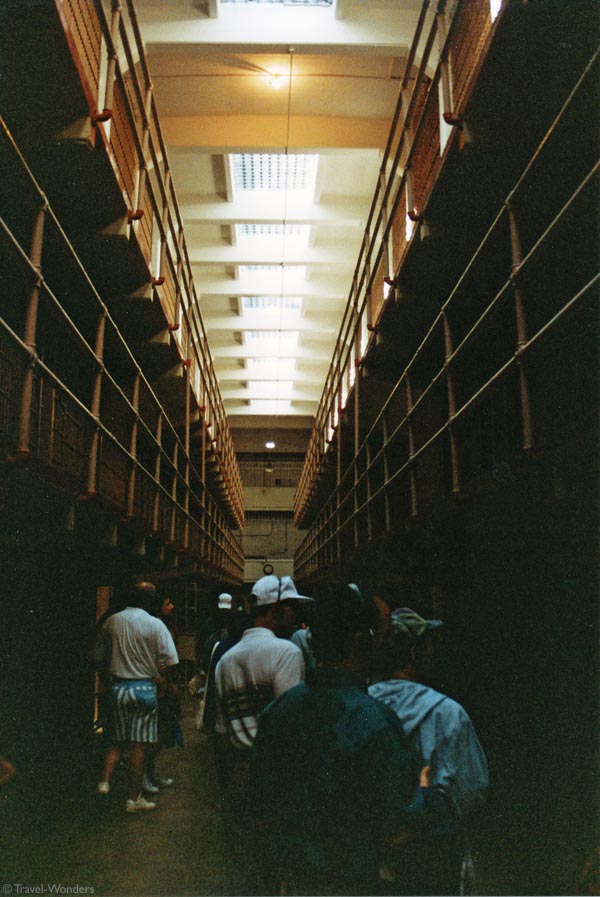 Walking down Broadway, the main prison passageway, shafts of life struggle through the narrow skylights to light an interminable string of tiny cells, each just five feet wide. My outstretched arms can touch both walls at once, a tiny wooden bed, chair and small shelf furnish the Spartan concrete cage. Yet the prison was shutdown as the cost per room exceeded that of San Francisco's finest luxury hotel.
 I feel the strict regimented life as I meander my way from the exercise yard (the playground) with its sombre grey walls, past the barber’s shop, the showers and library to the dining hall. Stunning vistas of the San Francisco skyline are visible from many vantage points – surely an extra torture as the prisoner’s munch an unappetising breakfast or snuggle up in their bunks at night.
Cell Block D contain the chilling solitary confinement cells with their tiny dingy cells holding misbehaving prisoners
The audio tour is the highlight of the visit and brings the place to life. Crisply told with entertaining accounts and detailed stories of prison life, the sobering narration complete with sound effects is fully conducted by past prisoners and ex-guard.
Using a re-fashioned vacuum cleaner motor and stolen spoons, three prisoners chiselled away damp concrete near an air-vent to make a famous escape on a raft of raincoats. To gain time, paper-mache dummies slept in their bed to pass the torch check during the night. Of the fourteen escape attempts and 36 escapees, these three remain unaccounted for – either drowned or soaking up life in Mexico?
Despite guards being unarmed within the prison and without keys on the prison floors, another tale details the capture of guards by prisoners who obtain guns and keys. Guards trapped in two cells are shot at point blank range. Cracks in the concrete floor from grenades highlight the re-capture of the prison as marines regained control. Around the island free from predators, various seabirds openly nest raising their chicks without threat.
While Alcatraz may sound touristy and clichéd, the boat journey across San Francisco Bay and the audio guide makes for a fascinating tour, realistically capturing the daily torturous life, unusual larger-than-life characters and occasional dramas of this famous island prison.
This article is kindly sponsored by HotelClub with hotel deals in over 69,000 hotels in 138 countries. San Francisco hotels include hotels near Pier 39 and hotels around the famous Lombard Street.

Monday, February 7, 2011
Exploring an Historic Botanical Gardens (Pamplemousses, Mauritius)

 While I love walking among the greenery and fresh air of the parklands and gardens of the world, I am not overly interested by the names and biological characteristics of each plant. However tucked away in a small Mauritian town and named for the bitter tasting grapefruit, Pamplemousses hosts an exceptional botanical gardens sure to capture anybody’s attention. Sadly many visitors don’t escape their beach resort to visit this superb gardens. A couple of hours wandering the wondrous Sir Seewoosagur Ramgoolam Botanic Gardens (or Jardins de Pamplemousses to its friends) in the north of Mauritius from the tongue-twisting name of the first Prime Minister, uncovers a fascinating array of tropical botanical treasures that should spark interest in anybody. The garden started in 1770 and is the oldest botanical gardens in the southern hemisphere.
 Following the palm-lined path from the wrought iron entrance gates, unusual trees abound. The Bleeding Tree dribbles crimson sap while the nearby grove of unusual Talipot Palms tower twenty metres into the air, flaunting its huge fan-tailed fronds. They flower just once after forty or fifty years in a stellar display of tens of millions of blossoms and then die. Sadly (or fortunately) none are in their full floral glory. The Fish Poison Tree is so potent that some Indian Ocean islanders grind the seeds and add it to water to stun fish, making for easy capture.
The gentle aroma of cloves, cinnamon and nutmeg fills the humid air from the Spice Corner (the origins of the gardens in an attempt to locally produce these valuable 18th century commodities).
A grand white marble obelisk commemorates those who generously donated their efforts to the gardens is coupled with a memorable quote: “The gift of a useful plant is more precious to me than the discovery of a gold mine, and a longer lasting monument than a pyramid”. The highlight of the gardens is the central lily pond. Like giant green footprints well over a metre wide, the lily pads span the lake. Starting as shrivelled emerald balls, they literally unfurl before your eyes, fully expanding in a couple of hours. Supposedly they hold the weight of a small child but responsible parents aren’t willing to test the theory. Remarkably the lily flowers, bloom white, turn pink on day two and die while elegant lotus flowers float graciously across the pond.
 Every corner of the gardens has surprises. A tiny animal area includes lumbering giant tortoises that thrive on the rich grasses. Small islands in the garden’s largest lake, dense in luxuriant vegetation are left to grow wild, palms and trees fighting for every square inch of this fertile area.
A garden memorial of author Bernardin de Saint-Pierre commemorates Mauritius’s greatest tale of love. An imaginary tomb recalls the tragic drowning of Virginie who modestly refused to remove her cumbersome dress as her ship sinks while Paul, her lover swims ashore. He dies a few years later of a broken heart for the loss of the love of his life.
Escape your resort and visit in the earlier morning to avoid the worst of the humidity, the well-maintained gardens make for an attractive and peaceful stroll experiencing an unusual variety and curious oddities of warm-weather plants. Take an inexpensive guide to get the most of this botanical wonderland hidden away on this mercurial African island.
Photo Credits: flowering Talipot

Friday, February 4, 2011
Photo of the Week: One Trillion Dollar Note (Zimbabwe)

This photo shows the colourful reverse side of Zimbabwe's short-lived one hundred trillion dollar note adorned with the iconic Victoria Falls. Worthless just a few weeks after being introduced in 2008 due to eye-watering hyperinflation, tyrannical government and the complete collapse of this once-bountiful African country, it is a strange feeling to receive such a high denomination note and speak in such gargantuan values. Sadly a shopping bag full of Zimbabwean banknotes were needed to buy the simplest of items and virtually all transactions were in US dollars.
Wikipedia notes that Zimbabwean inflation reached 65 million googol percent (65 followed by 107 zeroes) with prices doubling daily, before being abandoned completely.
Tuesday, February 1, 2011
Drinks Around the World: Horchata (Valencia, Spain)

Valencia and eastern Spain is famous for a traditional sweet milky drink called Horchata (or orxata de xufa in the local Catalan language). Originally introduced by the Moors around 1000 years ago, the drink is so popular that horchaterias, a kind of cafe, are in several of the Valencian towns.
Made from tigernuts (the tuberous roots of a kind of grass) mixed with water and sugar, and served icy cold, it looks like a milkshake and tastes of a very sweet non-dairy milk. Too sweet for my tastes, it is surprisingly refreshing. The highlight of the drink is that it is typically accompanied by tasty finger-shaped pastries called fartons that can optionally be coated in chocolate or filled with custard.
----------
Travel Wonders highlights a characteristic drink experienced on his travels. Prior articles have featured drinks as widely varied as Vietnamese slow-drip coffee, Austrian Almdudler, African zobo, Green Mint Tea from Morocco and cherry beer (Belgium).
Photo Credit: horchata
Subscribe to:
Comments (Atom)