Even as a child, I recall learning of the huge importance of the Nile flood plain to the ancient Egyptians as their source of crops. Twisting its way through the Sahara Desert, the Nile was the lifeblood of Egypt throughout the ages.
This hazy photo snapped from a plane flying to Luxor shows the sharp contrast between the rich, fertile soils of the Nile and the arid sands of the Egyptian desert. Every square inch of arable land is dedicated to growing food, the housing relegated to the desert sands. I think the photo captures in the sharp contrast of green and yellow, the significance of the Nile as a source of food and transportation and its support of virtually the entire Egyptian population who live within a short distance of this meandering famed river.
Friday, July 30, 2010
Photo of the Week - The Nile: Lifeblood of Egypt


Tuesday, July 27, 2010
The Rocks Aroma Festival and Marilyn (Sydney)

 Around 5,200 cups, 780 litres of coffee and 680 litres of milk were used to produce a stunning caffeinated mosaic of Marilyn Monroe at the historic Rocks area in Sydney last Sunday. As part of Sydney’s annual Aroma festival, a group of creative artists sculptured a sultry image of Marilyn over around four hours armed only with cups of coffee. The folks have a claim with the Guinness Book of Records of it being the world’s largest coffee mosaic (see it on video).
  Over 100,000 Sydneysiders and visitors sampled their way through coffees, teas, chocolates, spices and tasty snacks as the who’s who of warm beverages promoted their various wares. The festival was split into four zones: the Latin quarter showcased the best of Central and South America, Europe highlighted the Italian and Greek passion for coffee, the Oasis adopted Turkey and its exotic culture and the Orient primarily promoted teas, chai and spices among dancing dragons and drummers. Music, dancing and street theatre rang out from all four quarters.
While people are probably still awake from overdosing on caffeine, the Aroma festival is a wonderful celebration of food, coffee, tea and music on the foreshores of Sydney Harbour.
Saturday, July 24, 2010
Five Breathtaking Sights in Norway
 by Keith Wild
Norway is one of the most captivating, scenic countries in the world. This is a list of five special Norwegian travel wonders.
1. The Northern Lights
When the conditions are just right in Norway, you can witness one of the most spectacular natural phenomenon on earth, the Aurora Borealis, otherwise known as the Northern Lights. Beautiful ribbons of colored light dance in the skies when the solar wind stream meets the earth's magnetic field, and you can watch them twist and turn like ribbons of living color as they zip overhead towards the North Pole.
Photographing the northern lights requires skill. But if you want to try, get away from the city lights, set up a tripod and patiently wait for the spectacle to unfold. But no mere picture can ever show the true beauty of this eerie and fascinating reminder of the subtle energies that wash across our planet from beyond.
2. Pulpit Rock Towering over the long narrow Lysefjord is the historic Pulpit rock (Preikestolen), a huge flat topped cliff which juts out of the steep surrounding mountains to offer breath taking views of the sea and lands below. There is a dizzying 400 meter drop from the top of Pulpit Rock, originally know as Hyvlatonnå, to the cold waters of the fjord.
You can reach it either by ferry or car, but be prepared for quite a walk to actually make the summit. The well worn trail is very steep in places, and not recommended in the depth of winter or early spring when the track can get slippery. But if you time it right, your two hour climb will be rewarded with the feeling of standing on top of the world.
3. Ice Hotel Norway You will never forget a visit to the Ice Hotel on the Alta River at the edge of the Arctic Circle. This incredible fantasy in ice is reconstructed each year and features amazing rooms with fur-lined ice beds. Beautifully crafted chandeliers of ice bathe the hotel in soft colors that reflect through the snow and ice carvings of Norwegian wildlife. The fabulous ice bar is a great place to warm up from the inside, because even the barstools and glasses are made of ice. The crystalline Ice Chapel conducts regular church services.
4. Urnes Stave Church This UNESCO World Heritage site holds fascinating glimpses of days gone by, with many of the original medieval decorations still in this stave church that was built in the 1100s entirely of wood. The old portal on the north wall displays an interesting carving that continues to baffle historians, who cannot seem to decide it if depicts a Christian icon or is telling the story of a far older Norse legend. The intricate carving is fascinating to contemplate, and stirs up images of the ancient tribes whose skilled craftsman left their legacy carved in this church's timbers.
5. Vigeland Sculpture Park  You will not soon forget a trip to view the incredible sculptures made by Gustav Vigeland located just three kilometers form the center of Oslo. Eighty acres of grounds invite visitors to stroll over the bridge to the main gate, through the wheel of life, past the fountain and on to the Monolith Plateau -- the main attraction of the park. Begun in 1924, it took 3 stone carvers 14 years to fashion the massive granite stone into a monolith displaying 121 intertwining figures that are said to represent man's desire to climb closer to spiritual wisdom.
Photo Credits: Northern Lights, Pulpit Rock, Ice Hotel, Stave Church, Vigeland
Wednesday, July 21, 2010
Enduring the Col du Tourmalet (France)

 Watching highlights of the Tour de France on television as I write this post, I can’t help but wonder if this isn’t the greatest endurance test of any sport. For twenty-one days, the finest road cyclists in the world ride the roads of France including the savage slopes of the Alps and Pyrénées. Over 15 million spectators stand by the roadside and on the slopes to watch the cyclists live at some point throughout the tour.
 Some years ago, I drove up a couple of the famed cycle passes of the Pyrénées (not during the race!!) and couldn’t help but be amazed by the steepness and narrowness of the roads even in a car. The most celebrated is the Col du Tourmalet, the highest road in the Pyrénées, where the cyclist climbs and winds his way through multiple hairpin turns over 1500 metres in a distance of around 20 kilometres. It is cycling at its most gruelling and is often where the race is won or lost.
 Names of favoured cyclist are painted across the roads while superb mountain vistas and verdant farmlands spill from the road’s edge while amateur cyclist struggle their way up this mighty climb throughout the warmer months.
 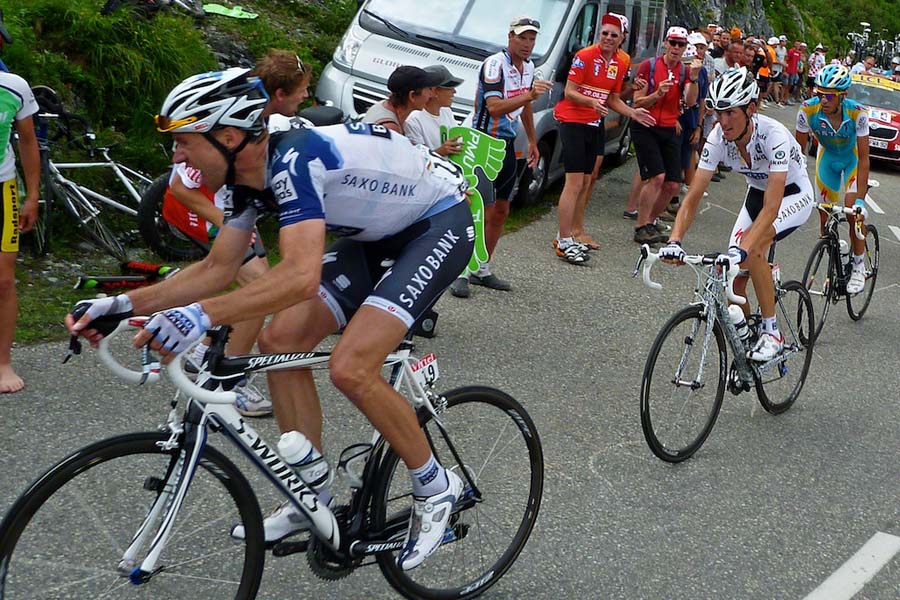 At the top, there was quite a gathering of cyclists (more than there are cars), primarily from France but some holidaying from other countries. I spoke briefly with a man from the nearby town of Pau who was in his sixties. Appearing decades younger in the sleekest and most colourful of cycling outfits, this diminutive Frenchman tells me that he has climbed this pass (along with other Pyrénéan passes) every year since he was sixteen – almost fifty years of cycling. He appeared fresh and relaxed and quietly proud of his achievement, even with his understated, dismissive way of discussing it. It is likely that he’d be now in his seventies and I wouldn’t mind betting that he’s continued to maintain his annual Pyrénées pilgrimage.
 Ironically, we chatted under the silvery monument to Octave Lapize, the rider up the first Tour de France climb of this mountain peak in 1910. The thought of riding this slope as a dirt track with a heavy steel, primitive, ungeared bicycle adds more to this achievement exactly 100 years ago.
The Pyrénées are one of the wonders of the world with their rich culture, glorious vistas and timeless villages. Every year in July, the strength, colour and bravery of the world’s cyclists bring the Pyrénéan mountain tops to life in the Tour de France.
Note: For a second great Pyrénées travel wonder, check out the Little Yellow Train.
Photo Credit: Tour de France
Sunday, July 18, 2010
The Natural Jacuzzi (Saturnia, Italy)

 In the south of Tuscany, a couple of kilometres south-east of its ancient namesake hillside village and west of the stunning Pitigliano are the remarkable hot springs of Saturnia. With the haphazard parking of cars and vans, a steady stream of half-naked people strolling along a dirt track and the less-than-subtle scent of sulphur wafting in the air, the Saturnia Cascades gushes warmed water from the Earth which settles into a series of small rock pools.
Gracelessly slithering down a natural stair to enter the hallowed waters, people step into the mineral-rich vivid turquoise bath. Even with a fair crowd of people chatting animatedly, the Saturnia hot springs are remarkably relaxing and a wonderful afternoon tonic to Tuscan adventures. Settling nearer the small waterfall offers a robust massage while sitting in one of the natural pools up to your neck is like bathing in champagne, the effervescence of tiny bubbles tingling the entire body.
With no change rooms, limited signage and a lone van selling ice-creams and cool drinks, this is as uncommercialised as can be. Lean back and enjoy the warming spa waters of this offbeat wonder of the world in much the same way as historic documents show that the Etruscans, Romans and Italians have done for over two millennia. And maybe like these predecessors, the memories will stay for a day or two as the sulphurous smell lingers despite any efforts to wash it off.