guest post by Sea France
It would be extremely difficult not to experience some of the local wine while holidaying in France, and lets face it, you probably wouldn’t want to. With some of the most delicious wines produced anywhere in the world, tasting wines is one of the best things about holidaying in France.
Holidaying in the different wine making regions of France has never been easier due to the many options for getting there. One of the easiest and cheapest ways to make the trip is by ferry and with many ferry to France deals appearing every day you can really make the trip at very little expense leaving more funds available to spend on wine!
Champagne  The vineyard area in Champagne has around 14,000 growers and 300 villages spread across three main growing areas. The majority of the growers here sell to the Champagne houses or co-operatives which are then blended into the famous brands or the supermarket labels we all know.
Of course this area is a great place to experience some of the world’s best champagnes, so if you like your fizz this may well be the place for you.
Bordeaux  Bordeaux is synonymous with fine wine but often demand can outstrip what is produced by the wine growers, meaning the top chateaux often charge very high prices for their wines. However, if you take a little time and look around you can often get very good Bordeaux while spending time in France. Make the trip to the outskirts of the region to visit the smaller grape growers and you’ll be sure to get yourself a great deal.
The Loire Valley
As this is one of the biggest wine producing regions in France, you’ll be safe in the knowledge that the wine will be delicious. Not only is the wine a real draw for visitors here, the scenery will provide stunning backdrops to the drink and the fine French food which accompanies it.
The region stretches from the coast near Nantes where you can experience Muscadet wine, through to Saumur, Anjou and Vouvrav where the wines of Cabernet Franc and Gamay reds can be enjoyed. If Sauvignon Blancs are you favourite then make sure you make the trip to Touraine.
Burgundy  The Burgundy region, located in central eastern France, is famous all around the world for its Chardonnay whites and Pinot Noir reds. In the same area though typically separately promoted are the Gamay red Beaujolais and chardonnay-based Chablis sub-region wines. Burgundy produces many different tasting wines despite the fact they are from the same grape. This is down to the different wine making practices of the individual growers and other factors such as the difference in climate, soil and drainage in the different areas.
The area stretches in a long narrow strip from Dijon in the north to Lyons in the south with a history that runs many centuries.
Photo Credits: bottles, grapevines, old bottles, tasting
Thursday, July 28, 2011
The Best Wine Regions in France


Monday, July 18, 2011
A Medieval Pilgrimmage (Rocamadour, France)

Over the centuries, pilgrims crawled up the 216 stairs on their knees to view and pray for a buried saint and a remarkable statue in this cliff-bound travel wonder. Today, bus-loads of “camera pilgrims” crowd the small hamlet of Rocamadour, shop enthusiastically at the throng of market stalls and take a private lift to even avoid expending energy walking.  From the nearby vantage points, Rocamadour is an awe-inspiring sight, perched precariously on a 150-metre cliff face of grey rock over four distinct levels. On the highest level called L’Hospitalet lies a château which offer a vista over the muddled complex of old houses, church spires, chapels, towers and staircases all threaded together via a single lane ancient street which curls through the levels of the township in a series of switchbacks. The middle layers contain a network of seven religious buildings including the Shrine of Notre Dame.
 Avoid the peak hours favoured by bus tour groups and this tiny village (population is only 600) develops a pious charm. Occasional devout pilgrims (wearing knee-pads) still crawl the Giant Escalier praying at the Stations of the Cross before reaching the chapel complex. Walking slowly up the narrow main artery of Rocamadour to savour the effort and feelings of centuries past, I can start to picture the pilgrimage some 800 years ago. In those times people had probably walked many hundreds of miles just to get to Rocamadour.
  The centre of attention is the venerable Black Virgin statue and its claimed miraculous powers including curing King Henry III of England in the mid-1200s. Also significant is the tomb of the Christian hermit Saint Amadour (where the township obtained its name) and some notable frescoes.
Rocamadour is a worthwhile diversion if travelling through central France. Enjoy the locally produced Rocamadour cheese and soak an evening away in this medieval travel wonder.

Thursday, March 17, 2011
Ambling around Chamonix (France)

guest post by Isabella Rose of MyDestinationInfo.com Home to the French Alps tallest peak, Chamonix taunts snow-sports enthusiasts with slopes just begging to be tarnished by the touch of skis. However, with the overshadowing call of the wily temptress, aka Mont Blanc, and the idyllic Chamonix weather, many have overlooked the effervescent town that sits at the base of her tumbling snowfall.
Unlike other French purpose-built ski resorts, naming no names of course (cough Courchevel cough), Chamonix is an authentic town whose vibrant streets buzz with the sounds of daily life. With historical sights and cultural attractions lining the town’s pedestrianized streets there are countless opportunities for ambling.
I feel I should take a short moment here to bask in the definition of ‘ambling’. Defined as ‘an unhurried or leisurely walk’, speed demons and adrenalin junkies who live to hurtle down mountains, jump out of airplanes and throw themselves of cliffs should really take note here. For my fellow ambling friends however, who similarly rejoice in the simple pleasure of a pleasant stroll, here are some of the best opportunities for ambling around in Chamonix.
Guided Heritage Tour Run by Chamonix’s local tourist office, a guided heritage walk around the town is an ambler’s dream. Beginning at Le Triangle de L’Amitié, home to the Mairie, Chamonix’s triumphant town hall, the tour continues on to explore Chamonix’s historic buildings and churches laced with the baroque and art deco style. On your way you will witness small pockets of hamlets and villages pervading the town, a testament to Chamonix’s diversity of life. With an abundance of cafes, restaurants and bars there is plenty of opportunity to refuel along the way. My ambling advice: check out the Chalet le Cerro, a quaint alpine chalet serving traditional French cuisine. The three-cheese fondue is worth the indulgence, just be warned your feet may feel a little heavier after this hearty feast!
Open Air Markets Chamonix’s open air markets thrive with the hustle and bustle of local trade, providing ample opportunity for ambling. Authentic Savoyard aromas float through the air tempting you with delicious French flavours. With home-grown produce and local dairy such as the Tomme and reblochon cheese, those who enjoy the finer things in life can bask in Chamonix’s rich culinary culture and the slower pace of European life. For those who prefer a seasonal market however, the Christmas Market Argentiere held at the local town hall is ideal for a winter’s stroll. Full of festive cheer, market stalls selling traditional decorations and wooden arts and crafts are offered up here for your leisurely perusal.
Chamonix Alpine Museum If ever there is a place where an ambler is truly at home it’s in a museum. Rich in visual history, Chamonix has several museum and gallery hot-spots. Tracing the history of the town’s origins, the Alpine Museum is a great place to start. From humble beginnings to a thriving ski resort proudly hosting the first Winter Olympics, the museum explores Chamonix’s rising success. With numerous prints, sketches and photographs to survey, art-amblers are bound to be busy for hours.
After a leisurely day of bumbling along Chamonix’s streets, you may find your legs a little shaky and your feet a little achy. Fear not! Hotels in Chamonix are a great place for expert-amblers to retire after a long day of exploration. From alpine lodges to catered chalets, swimming pools and Jacuzzi’s are on hand to provide a soothing soak at the end of the day.
For a more information on Chamonix peruse the pages of My Destination Chamonix, one of the best comprehensive guides on the area.
Photo Credits: reflection, flags, spice market
Saturday, January 29, 2011
The Worlds First Comic Strip (Bayeux, France)

guest post by Vera Marie Badertscher, A Traveler's Library  Some wonders of the world consist of rock and water, spectacular plants or unusual animals. I visited a true wonder of the world that consists of a piece of linen material and a whole lot of wool thread.
At first I thought that the Bayeux Tapestry would be of interest simply because it is old. And it is an impressive 934 years old in 2011. Created in 1077, it tells the story of the Battle of Hastings in 1066.
But telling history by recounting the dates of battles can put anybody to sleep. That's why, when I donned earphones and entered the dim hall of the Bayeux Tapestry Museum to shuffle slowly around the length of the glass-encased tapestry, I was surprised and delighted to learn that this old piece of cloth brings history vividly, and sometimes amusingly, to life. First you notice that this is not a woven tapestry. It is, instead, an embroidery made by unknown fabric artists with just ten colors of wool yarn. Although the creators were once thought to be William's wife and the ladies of her court, current speculation says it was French nuns who did the work. The 75-yard (68.6 m.) long embroidery, only twenty inches (50 cm.) from top to bottom, shows scenes of plotting, betrayal, travel, battle, and triumph in what might be dubbed the world's oldest comic strip. Little vignettes on the border shows fantastic, mythical beasts and scenes from morality tales, including some pretty bawdy ones.
 You can learn what soldiers wore, what their ships and horse tack looked like, how they ate and fought in the period when Normans (Norsemen--Vikings) were becoming the rulers of most of France, and led by William, conquering England as well. Somebody has counted 626 people in the tapestry, and of course William (about to gain the title “the Conqueror”) stands out as the most important. I was fascinated by the fact that William's brother Odon, the bishop of Bayeux, fought by his side. And when they returned victorious to Bayeux, Odon commissioned the story-telling embroidery for the consecration of his new cathedral, Notre Dame of Bayeux.
 At the Tapestry Museum, you will also learn that the tapestry has led a life nearly as adventurous as William the Conqueror's. It was periodically hung around the edges of the cathedral's interior, and in between festivals, the finely woven cloth was folded into an unbelievably small wooden chest--about a yard long and not that high--that still sits in the Treasury of the cathedral. Two fires ravished the cathedral, but the tapestry survived. French revolutionaries threatened to cut it in pieces because they were against anything religious. Small pieces disappeared over the years as people helped themselves to souvenirs. Napoleon grabbed it at one point, and it was moved from place to place, including in the Louvre during WW II.
 In 1983 it was moved to its present location in a former seminary
So when you are in Bayeux to visit this tough survivor-- the tapestry, which is really an embroidery-- cross the cobblestone courtyard with the model of a Viking boat and go across the street to the Cathedral. There you will be in the presence of Bishop Odon, and his brother, William the Conqueror, who attended the consecration of Notre Dame of Bayeux. History definitely becomes more interesting than a string of dates, with such visible remnants as the Bayeux tapestry and Cathedral to see.
Vera Marie Badertscher writes about books and movies that inspire travel at A Traveler's Library. She also blogs about 20th century Navajo artist, Quincy Tahoma. The biography of Tahoma that she co-authored with Charnell Havens will be published in April 2011.

Wednesday, January 5, 2011
Discover the Most Beautiful Villages in France: Part 3
Escaping the rush of Paris and the insane summers of the French beaches, rural France is best experienced in its small villages that sprinkle the country. The best are associated under the banner of Les Plus Beaux Villages de France. Part One explored villages in the south and Alps regions of France while Part Two explored the French villages of Normandy and the Dordogne. A further four villages scattered across France completes this tour of an often ignored aspect of French travel.
St-Cirq Lapopie
Perched majestically above the the Lot River, St-Cirq Lapopie seems lost in time. Small half-timbered and stone houses guarded by town gates front onto narrow alleys named for their crafts practised centuries ago. Today the small village with a population of less than 100 is popular with artists offering pottery, paintings, metalwork and wooden carvings.
Noyers-sur-Serein
In the heart of the world famous wine district of Burgundy, Noyers has a surprisingly untouristy and quiet feel to it. While angled historic half-timbered houses litter the small town, the highlight is the peaceful verdant stroll along the gentle bend of the Surein River and 700 year old village walls.
Gordes
Like a terraced Asian farm, the houses of the Provence village of Gordes sits upon a hill in layers, crested by a grey-stone chateau and imposing monastery. Some escape from the rampant summer visitors packed into the narrow lanes to visit the nearby Village des Bories, where around 20 ancient pyramid-shaped stone huts exist in an area continuously inhabited since the Bronze Age.
Collonges-la-Rouge
With a tiny population, the aptly named central French village exists entirely of houses, rounded towers, churches, castles and town walls constructed from blood red sandstone. Near the pilgrimage town of Rocamadour and contrasted with the verdant green shrubbery, the streets of the village can be explored in a handful of minutes but warrant the extra time to soak in the history of a small town overflowing with historic and listed buildings.
While France is the most visited country on Earth, too many people fail to escape Paris for part of their break missing the walking delights, rich history and gastronomic pleasures of some of the most beautiful villages of France. Make sure your vacation in France includes at least one small village and vive la difference.

Sunday, January 2, 2011
Discover the Most Beautiful Villages in France: Part 2
France is sprinkled with beguiling villages, many frozen in time that encapsulate much of what people love about this European cultural giant. Associated under the banner of Les Plus Beaux Villages de France, these villages share the historic, gastronomic and enchanting nature of rural France. Part One explored villages in the south and Alps regions of France while today we explore Normandy and the Dordogne.
Saint-Céneri-le-Gérei
It is difficult to imagine anything more relaxing than sitting by the peaceful Sarthe River near a rustic old stone bridge chewing on a pate-laden crusty baguette and sipping a refreshing glass of red. This quiet Norman village of ivy-covered stone houses and narrow lanes has developed a pilgrimage following the creation of a church-side miracle spring associated with the cure of eye diseases.
Le Bec-Hellouin
In rural Normandy, sits the photogenic half-timbered houses of the village of Le Bec Hellouin. Painted in vibrant colours surrounded by verdant green footpaths and parks and bedecked with blooming flower boxes, the village charm is complemented by the wondrous ceramics of the 1000 year old abbey and its resident monks.
Beynac-et-Cazenac
Overlooked by its imposing castle standngn guard over the Dordogne River in central France, the cobbled laneways of the tiny village of Beynac (around 500 people) is one of several Perigord villages that sit at the gateway to the extraordinary caves (including the world famous Lascaux) with their 20,000 year old Paleolithic paintings. Their rich gastronomic culture is highlighted with the squawking geese and ducks or the stalls that sell and sample the fine patés of the region. Hiking (randonnées) is popular on well-marked paths that link the villages and take in the famous limestone caves.
Saint-Léon-sur-Vézère
Guarded by a remarkable three castles, the picturesque Perigord village is near the historic caves and rock shelters of La Roque St Christophe occupied by Paleolithic or Stone Age people around 55,000 years ago. While there is a rudimentary understanding of life back then, much still remains unexplained. It is a remarkable feeling to stroll along the rock ledges trying to imagine people huddled over fires eking out their lives so long ago.
Join us for a final roundup of most beautiful villages in France.
Sunday, December 19, 2010
Discover the Most Beautiful Villages in France
 With its excellence in selling itself, the French encourage visitors to enjoy some of France's most elegant and photogenic villages. Highlighting villages with populations of less than 2000 people that boast at least two historic monuments or sites and striking architecture, unique culture or natural beauty, an initial book published in the early 1980s led to an association of around 150 villages that proudly call themselves The Most Beautiful Villages in France. Sprinkled throughout the country and highlighted by the above logo, here are ten personal favourites from those that I have visited over the years in this most enchanting of European countries.
Yvoire Bordering the sparkling beauty of Lac Léman (as the French call Lake Geneva), this medieval fishing village with its stone houses and wooden balconies glisten in geranium and wisteria blooms in summer. Whether wandering its narrow streets spotting signs of its ancient castle its 700 years of history, paddling the shores in a tiny canoe or enjoying the colour of the Garden of Five Senses, Yvoire is a wonderful diversion heading towards Switzerland.
Roussillon
Experiencing Rousillon has two contrasting feels - the narrow paths, archways and roughened walls of the historic village (over 1000 years old) and the other-worldly trail through the golden yellows, burnt oranges and flame reds of the largest ochre deposits in Europe. The area is sprinkled with painters and their easels enjoying the rich colours and strange shapes of the historically-valued clay fields or the towering bell tower and expressive town squares.
Villefranche-de-Conflent
Surrounded by its World Heritage-listed defensive walls and shaped like a boomerang, the tiny town offers its best panorama from Fort Liberia. Boasting delicate formations in its neighbouring limestone cave, the town is the launching pad for the superb Pyreneean rail journey on the Little Yellow Train.
More of France's most beautiful villages can be found here.
Sunday, December 12, 2010
Pont du Gard: A Roman Marvel (France)
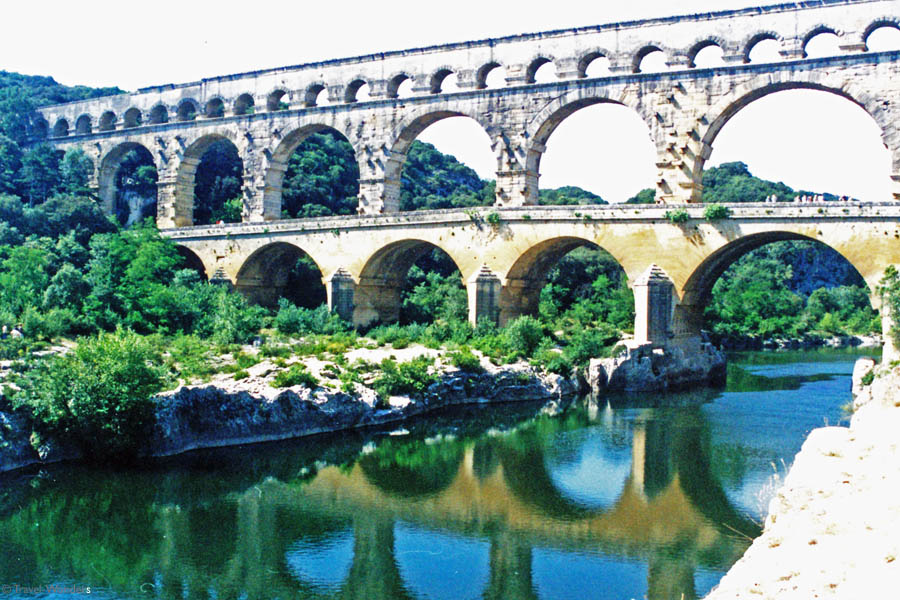
The first sight of Pont du Gard is striking. Set in a picturesque valley and with its towering three arched structure reflected into the peaceful river below, it is extraordinary to realise that the bridge was built around the time of Christ as part of a water supply system to the Roman capital of the area, Nîmes (which is well worth a visit with its Roman amphitheatre, Roman house and ancient gates). The huge limestone blocks (many over a tonne) are held together without mortar – a remarkable Pyramid-like construction effort. Its three layer grand arch stands nearly 50 metres tall (the highest Roman aqueduct in the world) and delivered 200 million litres of water per day from the springs in Uzès to the good folks of Nîmes (the exit point still exists today). The engineering for the times is exceptional, the waterway dropping just seventeen metres over the distance of 50 kilometres (the water took over a day to make its full journey, much of it via underground trenches) and the bridge being responsible for a drop of just one inch over its span of half a kilometre.
 Somewhat fortunately, the bridge survived the middle ages, being a tollway granted to the church in exchange for maintaining the structure.
Walks in the area (as well as across the bridge) offer a variety of views of the bridge and surrounding area with information signs along the paths highlighting the rich history of the bridge. Sadly the bridge is ridiculously popular in summer and has been somewhat commercialised with mediocre extras such as a museum, film and info centre.
Being so shallow, the waters of the Gard River are warm, many visitors escaping the heat of southern France by swimming, canoeing or liloing on the gently flowing stream.
Go early in the day to avoid the crowds and the heat, the Pont du Gard being only a short 25 kilometres from Avignon. It makes for a worthwhile diversion to marvel at the remarkable scientific and engineering skills of the Romans, protected with its entry on the World Heritage List).
Wednesday, July 21, 2010
Enduring the Col du Tourmalet (France)

 Watching highlights of the Tour de France on television as I write this post, I can’t help but wonder if this isn’t the greatest endurance test of any sport. For twenty-one days, the finest road cyclists in the world ride the roads of France including the savage slopes of the Alps and Pyrénées. Over 15 million spectators stand by the roadside and on the slopes to watch the cyclists live at some point throughout the tour.
 Some years ago, I drove up a couple of the famed cycle passes of the Pyrénées (not during the race!!) and couldn’t help but be amazed by the steepness and narrowness of the roads even in a car. The most celebrated is the Col du Tourmalet, the highest road in the Pyrénées, where the cyclist climbs and winds his way through multiple hairpin turns over 1500 metres in a distance of around 20 kilometres. It is cycling at its most gruelling and is often where the race is won or lost.
 Names of favoured cyclist are painted across the roads while superb mountain vistas and verdant farmlands spill from the road’s edge while amateur cyclist struggle their way up this mighty climb throughout the warmer months.
 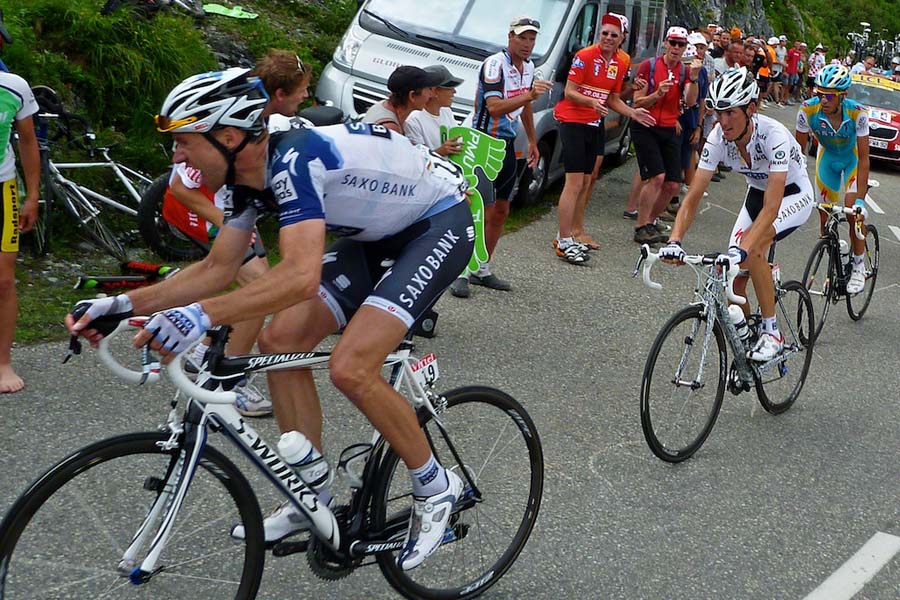 At the top, there was quite a gathering of cyclists (more than there are cars), primarily from France but some holidaying from other countries. I spoke briefly with a man from the nearby town of Pau who was in his sixties. Appearing decades younger in the sleekest and most colourful of cycling outfits, this diminutive Frenchman tells me that he has climbed this pass (along with other Pyrénéan passes) every year since he was sixteen – almost fifty years of cycling. He appeared fresh and relaxed and quietly proud of his achievement, even with his understated, dismissive way of discussing it. It is likely that he’d be now in his seventies and I wouldn’t mind betting that he’s continued to maintain his annual Pyrénées pilgrimage.
 Ironically, we chatted under the silvery monument to Octave Lapize, the rider up the first Tour de France climb of this mountain peak in 1910. The thought of riding this slope as a dirt track with a heavy steel, primitive, ungeared bicycle adds more to this achievement exactly 100 years ago.
The Pyrénées are one of the wonders of the world with their rich culture, glorious vistas and timeless villages. Every year in July, the strength, colour and bravery of the world’s cyclists bring the Pyrénéan mountain tops to life in the Tour de France.
Note: For a second great Pyrénées travel wonder, check out the Little Yellow Train.
Photo Credit: Tour de France
Saturday, June 26, 2010
Cote d'Azur Villas (France)

guest post The Cote d'Azur, also knows as the French Riviera or Gold Coast, is located on the southern end of France along the Mediterranean Sea. With a climate that boasts over 300 days a year of sunshine and mild temperatures, beautiful azure waters, and the Alps as a backdrop, this area has long been one of the most sought-after havens by those searching for the ideal spot for truly luxurious relaxation in one of the many Cote d’Azur villas.
The French Riviera has an almost tropic climate, making it the perfect spot for all types of outdoor sports and leisure activities. Beautiful villas dot the beaches and hills, and lovely yachts dot the waters. At least 90% of all superyachts dock in the waters of the Cote d’Azur during their sailing lives, making it a haven for seagoing luxury.
Hiring your own villa may be the best way to see the Cote d'Azur. By renting your home, you have a base of operations from which to explore this beautiful area, and can enjoy the excitement of all the Cote d'Azur has to offer.
The cities of this area, Nice, Antibes, Saint-Tropez, and Cannes, have become symbols of the best in art, jazz, shopping, and film. It is not unusual to spot movie stars and the super-rich enjoying the beautiful atmosphere of these towns, or enjoying playing in the bright waters and wandering through the lovely cities and villages. The cities of the Cote d'Azur combine Old-World charm and history with modern amenities. Side-by-side with the narrow, winding streets and ancient buildings of the old cities exist the exciting, vibrant markets and shopping rows with shopping opportunities ranging from antiques to some of the most-coveted and exclusive labels in the world. Art has always been a significant feature of these cities, whether it is painting, writing, or film, and many artists have found their inspiration here.
 Wonderful sightseeing is only a step away from your villa. You can take a drive through the beautiful countryside, rent a bicycle and explore the lovely hills around the coast, book a tour covering the history of the area, or just wander along the narrow, cobbled lanes of the old cities. Whatever you choose to do, you will find no shortage of beautiful architecture, churches, and natural wonders. The cities abound in museums, cathedrals, and other points of interest. The countryside is also worth any amount of sightseeing, simply to enjoy the beauty of the natural surroundings.
Photo Credits: St Tropez Harbour, Sailing Sunset, Beads, Antibes Street