guest post by Gills Cruise
Europe is steeped in thousands of years of history, with countless historical sites and iconic buildings at every port. On a cruise around the Mediterranean, you have a choice of so many picturesque ports that it’s difficult to know what itinerary to choose.
Whether you want to explore Europe’s ancient ruins, buy yourself something nice in one of the boutique shops, dine on healthy Mediterranean cuisine or top up your tan on Europe’s sun-drenched beaches, there’s something for everyone on a Mediterranean cruise. Summer is the peak time for people to go on Mediterranean cruises, for obvious reasons. The weather is warm, the sun is shining, and you can see the sights without fear of it raining. However there are also year-round cruises for people who prefer to visit Europe minus the intense heat and hordes of tourists.
From smaller ships to big luxury liners, there are a wide variety of cruise ships to choose from. You have the choice of cruising directly from Southampton in the UK with companies like P and O Cruises and Royal Caribbean, or you can fly to meet your ship in one of the major ports like Barcelona, Palma or Venice. Cruises tend to be divided into Eastern and Western Mediterranean; Eastern cruises visit places like Cyprus, Turkey and Egypt, whilst Western cruises travel around Spain, France and Italy. If you’re planning to go on a Mediterranean cruise, these are some of the top ports to stop at on your voyage around the Med.  Haifa- In past years cruise liners avoided Israel due to safety concerns, but this year Israel is back on the map. Several cruise lines, including Celebrity Cruises, Royal Caribbean International, Windstar, Norwegian Cruise Line, Azamers Club Cruises, Princess Cruises and Costa Cruises, will have stops in Israel this summer. If you stop in Haifa you can visit Nazareth and Galilee, and if you dock in Ashdod you can go to Jerusalem and Bethlehem.
 Venice- One of the most romantic cities in the world, Venice is a popular place for people to board their cruise, with plenty of things to see and do if you want to stay a few days. Go for a ride on a gondola down the canals, take in the atmosphere at St. Mark’s Basilica and experience the shopping and fine dining at Rialto Bridge. Venice is a series of small, connected islands so there are no cars. Getting around Venice involves taking the Vaporatto or a water taxi.
Santorini- Santorini in the Greek Islands is a romantic, beautiful island with a dramatic volcanic landscape, incredible ocean views, and whitewashed buildings with blue dome-shaped roofs. Everywhere you turn on Santorini you are presented with a perfect photo opportunity. Sunbathe on one of the black sand beaches, ride quad bikes around the island and view the orange and pink hues of the sunset from the cliffs of Oia.
Rome- Rome in Italy is literally an outdoor museum, full of iconic ancient sites. Visit the Vatican where the Pope resides, throw money in the Trevi Fountain, and imagine you’re in The Gladiator as you gaze in awe at the Colosseum. The food in Italy is to die for, so you can spend your days eating pasta, pizza and gelado.  Lisbon- Whilst many cities are rather flat, Portugal’s capital is a pretty city built on a series of hills, so you’ll be doing plenty of walking uphill. Take a ride on a historic tram, sit and have coffee in Rossio Square, do some shopping on Rua Augusta and walk through the grand Triumphal Arch to the huge square, Praca de Comercio. Walk up the hill to the Biarro Alto district where there are trendy bars, cafés, old clothing stores, bookshops and artisans workshops. Climb up the hill to Castelo St. George and enjoy the panoramic views of Lisbon and the ocean.
Istanbul- Lying on the crossroads between the continents of Europe and Asia, Istanbul is a place where East meets West. Istanbul was Europe’s capital of culture in 2010 and has a rich and colorful history, so there are plenty of historical sites to feast your eyes on. Visit the ancient city of Troy where Achilles fought the Trojans, or wander the Anzac fields of Gallipoli. Take a photo of the two most famous landmarks in Istanbul; the Blue Mosque and Aya Sofia. Barter for souvenirs in the Grand Bazaar with over 4,000 merchants, savour the Ottoman cuisine, and dance the night away in one of the best party cities in the world.  Dubrovnik- Walking tours will take you around Dubrovnik’s walls to explore the Pearl of the Adriatic. Whilst few of Croatia’s Renaissance buildings survived the 1667 earthquake, you can still see Sponza Palace, St. Saviour’s Church and St. Blaise’s Church. Take a stroll down the main pedestrian walkway, Placa, which is lined with cafes and shops, and explore Dubrovnik’s churches, monasteries and museums.
  Barcelona- A favourite pastime in Barcelona is strolling down Las Ramblas Boulevard, with its shops and street artists. Many of the big ships dock quite close to Las Ramblas and offer a shuttle service to this pedestrian area. See famous works of art such as the Picasso Museum and Gaudi’s unfinished but beautiful Sagrada Familia. Wander around the narrow streets of the Gothic Quarter, with its galleries and stunning architecture.
Naples- Naples is close to the ruins of Pompeii as well as the volcano of Mount Vesuvius, which erupted and destroyed most of Pompeii. Naples is also home to the largest collection of artifacts from the Roman Empire, which can be found in the National Archeology Museum. From Naples you are also within easy reach of the glamorous island of Capri.  Athens- As the oldest city in Europe, Athens is a favourite stop on Mediterranean cruises and is a must-see for history buffs wanting to discover the ruins of ancient civilizations. The highlight is the Acropolis, which sits up high overlooking the city and the bustling streets below. Athens is also the home of the Olympics, and has undergone urban renewal since it hosted the Olympics in 2004.
Monte Carlo- Full of glitz, glamour, sports cars and celebrities, Monte Carlo on the French Riviera is as glamorous http://www.blogger.com/img/blank.gifas it gets. This wealthy city is famous for the legendary Casino Royale, Grace Kelly, the Monaco Grand Prix and the Prince’s Palace. Take a look around the Palace, sip on a cup of coffee at Café du Paris, stroll around the harbour with its luxury yachts, and take a peek inside the Casino, even if you can’t afford to gamble.
Photo Credits: ship, Haifa
Thursday, March 31, 2011
The Best Ports to Visit on a Mediterranean Cruise with P&O Cruises


Monday, March 28, 2011
Roman History in Croatia (Pula, Croatia)

 Not many cities can boast a Roman amphitheatre in the centre of town. Pula is strategically perched at the bottom of the Istrian peninsula in the west of Croatia and is dotted with several monuments from the Roman era. It isn’t difficult to imagine toga-clad men walking the streets and gathering in the main forum in a city whose layout appears unchanged for two millennia.
 Several Roman gates all built around 2000 years ago lead to a city with a number of cobbled streets highlighting a rich history of Roman, Byzantine, Venetian and Austrian occupation. With their remarkable engineering and architecture it is little wonder that there is more evidence of the Romans than any other, including a temple, mosaics and an old theatre. The oldest Roman city entrance is the elegant Gate of Hercules (with surrounding town walls built later) with the badly eroded carving of Hercules and his club at the top of the arch and the names of the two Roman officials (one was the brother of Cassius who killed Julius Caesar) who led the building of the city.
 The main square was once the Roman Forum and boasts the harmonious columned Temple of Romae and Augustus. Around 2000 years old, I wonder how many of today’s building will be viewed in the same majesty 2000 years from now. Mind you, this one didn’t survive a bomb late in World War II and was carefully recreated after the war.
 However the undoubted highlight of Pula is the Arena, a large Roman amphitheatre that held over 25000 spectators in its day and continues to see concerts and performances today though only with audiences of 5000 (varying from Pavarotti to Elton John). Engagingly lit at night and the same age as its famous cousin in central Rome, it was sadly denuded internally over the centuries (the seats and some of the underground areas) to supply building material for other projects by the Venetians (including the four-pointed star shaped castle which provides the best external view of the Arena and now hosts the Istrian History Museum). At one point, the Venetians considered dismantling the whole amphitheatre and re-erecting it in Venice, but Pula eventually got to maintain its treasured attraction.
The Arenadesign is impressive with the stadium being three levels on the side facing the sea and two levels on the other side to account for a marked incline in the land.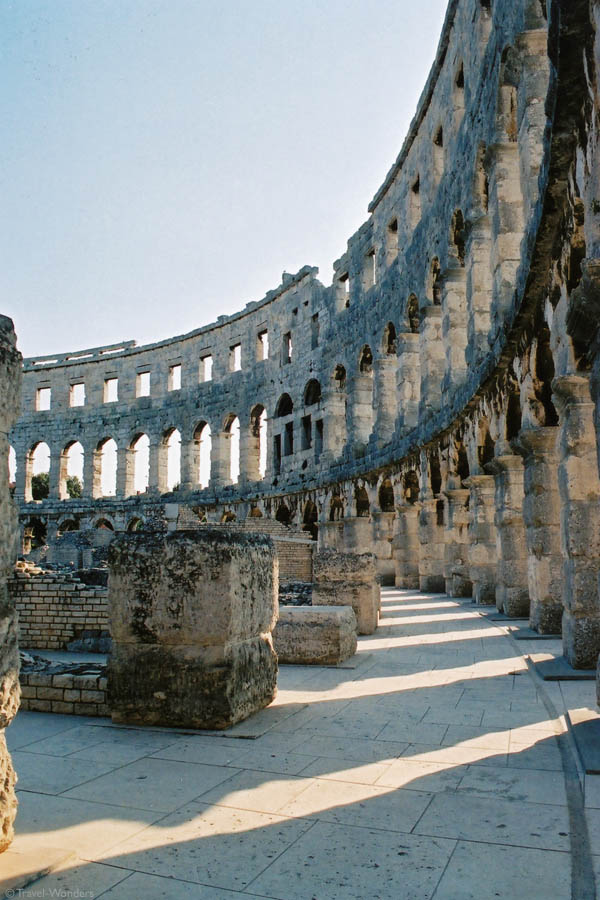 The underground areas have been replaced but with a fairly thoughtless and careless cement and concrete approach. However, it does give a good sense as to the complex arrangement of managing the various wild animals, sets and gladiators that provided entertainment for a lusting audience.
In the spirit of remarkable engineering, structures at the top of the 30 metre well-preserved walls of the amphitheatre show that the complex could be fitted with awnings for hot or wet weather and the towers contained water tanks to provide fountains during the shows (the Romans think of everything!!). Croatian pride in their Roman treasure includes featuring it on the ten Kuna note (around US$2) though the mint uses artist’s discretion to remove the various scaffolds and repair areas that mar photographers’ efforts!!http://www.blogger.com/img/blank.gif
Pula provides an excellent day wandering the Roman monuments that dot the city and provides an excellent base for exploring the Istrian hill towns, including such travel wonders as Matovun, Buzet, Labin and Hum (the smallest city in the world). Make sure that you grab a copy of the Arena audio tour to discover the innovative building and design methods used in constructing this superb entertainment centre of over two thousand years of age.

Friday, March 25, 2011
Three of the World’s Greatest Cruises

by Sanctuary Retreats
Cruising is an increasingly popular choice of holiday for millions of people. Cruising gives holiday makers access to a variety of amazing destinations that would be impossible to visit during a traditional hotel based break. On a cruise you can wake up to a new and exciting destination almost every day while still getting to enjoy all the comforts and facilities of the finest hotels. You will find cruises to take you to almost every corner of the world, but there are a few cruises that are unlike any other.
 Sailing along the Nile in Egypt is one such cruise. The Nile is a stunning river which has been the centre of a truly fascinating history and culture. On one of these luxury Egypt holidays you will get to see first hand the heartland of ancient Egypt and marvel at monuments and relics that are thousands of years old. Egypt’s rich history has left behind a wealth of artifacts and ruins that are just waiting to be explored and experienced. With such treasures on offer it is no wonder so many people become enchanted with Egypt.
 Egypt is not the only country to offer a rich and rewarding river cruise. China is home to vast panoramic landscapes and an enthralling history which has left many monuments and landmarks. China’s most iconic river cruise is undoubtedly the Three Gorges cruise on the mighty Yangtse which gives tourists an unparalleled Chinese experience. The Three Gorges offer some of the most beautiful landscapes in China and are certain to make for an unforgettable holiday.
 The Galapagos Islands are a group of islands unlike any other; it is little wonder they proved to be such a source of inspiration for Charles Darwin. These islands are located 605 miles off the coast of Ecuador, which is itself a truly amazing place. The islands often described as one of the Seven Wonders of the World which you may think is pure hyperbole but once you have seen the Galapagos for yourself you will realise it is completely justified. Great luxury cruises are available to tour these islands and allow you to see the unique flora and fauna which have fascinated and inspired so many people for centuries.
Photo Credits: flamingo, temple, three gorges, penguin
Wednesday, March 23, 2011
Photo of the Week: Mount Ngauruhoe (New Zealand)

Published as part of the Blog4NZ campaign (twitter #blog4nz) to highlight the travel wonders of New Zealand and to promote that New Zealand is very much open to tourism despite the recent earthquake in Christchurch.
Mt Ngauruhoe is a stunning conical and highly active volcano in the centre of the North Island of New Zealand and part of the exceptional one day Tongariro Alpine Crossing trek.
Sunday, March 20, 2011
Thermal Wonderland (Rotorua, New Zealand)

Australians have always felt a close affinity with our New Zealand cousins. As a travel destination, New Zealand is one of the world’s most inviting destinations – dominated by extraordinary scenery of glorious mountain ranges, untouched forests, stellar national parks and sparkling oceans and complemented with a vibrant and deeply respected Maori culture (a lesson for the world) and an easy-going, unrushed population.  While Christchurch has started to rebuild from a devastating earthquake that caused untold damage, took over 150 lives and shredded the fundamental infrastructure of the city, travellers assumed that all of New Zealand was a disaster zone and closed down. Nothing could be further from the truth. An initiative of a group of Kiwi travel bloggers under the banner of Blog4NZ (twitter: #blog4nz) have encouraged over 100 bloggers worldwide to publish favourite stories of this vibrant country to encourage the world to visit. Tourism comprises around 10% of the New Zealand economy and so each visitor can help in a small way to help rebuild the South Island’s largest city and the impact on the country in general. Note that the Christchurch Airport continues to operate normally and is the perfect gateway to the South Island and its incredible natural beauty.
This article describes the unusual thermal region of Rotorua (visited in September, 2010) but readers can find other New Zealand stories on the Waitomo Glowworm Caves, the steepest street in the world and the thunderous Huka Falls.  The odorous rotten-egg gas hits me first. Within a few miles of Rotorua, the rich sulphurous air gives a taste of a remarkable landscape. Revered by the Maoris, the highlight of the area is Te Whakarewarewa which everyone confidently and loudly calls fa-ka (wh is pronounced f in Maori).
Presented almost as a mini-New Zealand, the area’s highlights are undoubtedly the spurting geysers, bubbling mud pools and steaming springs. Just past the symbolic entrance of raised wooden poles is the Kiwi House. New Zealand’s iconic bird forages in the semi-darkness, its plump body, matted feathers and strange long beak difficult to spot in the nocturnal conditions that Kiwis prefer. Sadly, there is little chance of seeing them in the wild so this is the best way to see this endangered fellow. Mating for life, the male Kiwi incubates the egg in one of nature’s more evenly shared breeding partnerships. From the Kiwi House, the inhospitable primeval landscape lays in front of my eyes. Geysers spurt and steam billows erratically from several spots rebelling against the chilly wintry air. Several pools of mud on permanent simmer bubble, gurgle and froth under a veil of steam, belching their foul-smelling gases into the air like the worst of house guests.
  Most of the geysers spurt from a multi-coloured lunar-like area called Geyser Flat. In a kind of thermal warm-up act, the grandly named Prince of Feathers geyser spurts before launching the most impressive Pohutu Geyser. Super-heated by molten rock under increasing pressure as steam builds underground, the boiling rainwater spurts many meters into the air with an impressive blast, before commencing the cycle over again. The active landscape is a reminder that geologically, New Zealand is one of the world’s youngest countries.
Strange holes seemingly lead to Middle Earth, the grey fringes giving a sense of foreboding about whether a geyser is about to shoot. Various activities utilising warming bore water for spas in the Rotorua area resulted in some geysers in the area stopping. As an indicator of Maori reverence for this site, a Maori cemetery overlooks the main geyser area, plain white headstones and carved wooden statues marking the buried ancestors. Homage is appropriately paid to the Maori God of Fire.
Nearby, a permanently boiling water hole was used for centuries by the Maoris as a cooking area and currently highlights the innovative cooking methods with woven baskets making ideal “pots” for dunking the eggs and vegetables.A boiled egg with such little fuss. The remainder of the site is a Maori cultural centre. With an area of pre-European Maori housing, a more modern marae or Maori meeting house and national schools for the Maori arts of weaving and carving, the Maori culture is well enshrined ensuring that their heritage and practices are not lost in modern society.
In the Maori weaving school, small clumps of the strands of the flax plant are expertly rolled across the leg forming long strings that are dyed and woven into clothing, baskets and other goods. Feathers and skins are often added for warmth or ceremonial appeal.
Around the area, I can strongly recommend completing a Rotorua day with a visit to one of several thermal pools (lose the silver jewellery first unless you want them all tarnished) for an incredibly therapeutic and relaxing experience.
Despite the odours, New Zealand's Sulphur City is a great place to visit, with the popular Whaka offering a chance to liven all the senses with the Earth's natural power in its rawest form across a thermal wonderland of geysers, boiling mud and venting steam. And to add the Kiwi flavour, a chance to experience two of the country's most identifiable images - to peer through the murkiness to witness a Kiwi scratching amongst the undergrowth and to watch a thriving Maori culture that harnesses the thermal area so harmoniously.