The flightless emu is native to Australia and is the second tallest bird in the world. Though not regularly seen in the wild, this one was sighted in Western Australia not far from the moonscape area of The Pinnacles. It seemed contented to stay near its waterhole. Despite their slightly bedraggled shaggy feathers, emus are powerful runners capable of deceptive speeds. Seeing a flock of emus running on the dusty outback ground is a spectacular sight.
 The emu is one of two animals on the Australian coat of arms supporting the shield. Both animals are notable for the fact that they cannot walk backwards, symbolic for Australia's forward progress.
Other Wildlife Photos of the Week
Osprey
Toucan
Cheetah
Mountain Gorilla
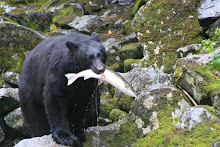
Brown Bear
Monday, May 25, 2009
Photo of the Week - Emu (Australia)


Friday, May 22, 2009
Pathways to the Gods (Nazca, Peru)
 Ever since reading Erich von Daniken’s Chariots of the Gods? as a child, I’ve been enchanted by the mysterious travel wonders of the Nazca Lines. Though, even as a child, I have never entertained the notion that this was used as an airport for alien spacecraft, the idea that a past culture etched super-sized motifs of animals, birds and sea-life into this harsh desert landscape struck me as truly bizarre.
Evidence that this ramshackle unattractive town once attracted an advanced culture is not only evident in the world-famous lines but also in a mesmerising aqueduct system that supplied water for farming the parched soils of this unforgiving desolate area. The geography of this area ensures that the lines created a couple of thousand years ago still exist. Each line and image is created as a single continuous line, clearing the thin layer of darker metallic soil and unveiling the pale coloured sandy ground below. Completely devoid of vegetation and with virtually no recorded rainfall and unchanging windless conditions, these small furrows etched into the soil have survived the ravages of time. Hundreds of lines and trapezoidal shapes, kilometres long, crisscross this huge arid expanse, combined with roughly seventy stylized animal figures or geoglyphs, many over 100 metres across.
 The only way to properly appreciate the sight is from the air. Not for those with weak stomachs, light aircraft take visitors on thirty to forty minute morning flights traversing the desert area and tipping the plane from side to side like a carnival ride to offer everyone good views of the most significant figures.
The spider has a special story. One theory is that it is a diagram of the sacred Orion constellation. Another details that it is a particular rare giant spider only found deep in the Amazon valley, many thousand of miles away. The male of this spider has its reproductive organ at the tail end of one of its legs (visible only under microscope) and this appendage is clear in photos of the Nazca image (it is the bottom left leg in the photo). A monkey with a spiral tail, a hummingbird, a killer whale, a condor, a strange astronaut figure, a huge lizard (cut in two by the highway, built before the figures were apparent), a dog, a spider, a flamingo (which is over 300 metres long) and other animal figures litter the landscape like a whimsical zoo, no geoglyph being repeated.
 With the spiral shape being an ancient symbol for water, a commodity more valuable than gold in this dusty parched environment, claims that the area represents a water ceremony for the gods may make more sense than some of the far-fetched theories espoused by supposed scientists. Whether this large Peruvian pampas was an extraterrestrial landing strip, an advanced astronomical and agricultural calendar, exotic ancient art or something completely different, we are unlikely to ever truly know. Being halfway between the capital, Lima, and the stunning colonial city of Arequipa, it is well worth a stop to view and wonder about these unforgettable desert markings, along with the ingenious aqueduct system and ancient burial grounds in the same area.
Other Peru Posts
Potatoes with your Guinea Pig, Sir?
Exploring the Incan Wonderland (Machu Picchu)
Trekking to the Lost City (Inca Trail)
Flight of the Condor (Colca Canyon)
Living in Reeds (Lake Titicaca)
Top Ten Travel Wonders of South America
Tuesday, May 19, 2009
The Waterfall Hidden in a Mountain (Trümmelbach Falls, Switzerland)

 If one location can summarise the travel wonder of the European Alps and Switzerland, it is Interlaken and the Bernese Oberland. Sandwiched between two sparkling azure lakes, Interlaken stares at the towering giants of Eiger, Mönch and Jungfrau and the snaking icy river, Aletsch Glacier, which is Europe’s longest. Beautiful days in nature can be spent wandering between the traditional mountain villages and through the scenic verdant valleys.

 One excellent journey starts by taking a train from Interlaken to Lauterbrunnen and walking around five kilometers along a well sign-posted route to Trümmelbach Falls. The crisp fresh air, the amphitheatre of mountains, the tranquil setting and the glorious blooming wildflowers all brighten the steps and quicken the stride. Glorious waterfalls tumble down niches in the rock walls, none more impressive than the 300 metres Staubbach Falls that seemingly tumbles into Lauterbrunnen itself and gives it its name of Valley of Loud Waters.
 In under an hour, the path crosses a small bridge with a raging torrent of water (turns out to be the bottom of Trümmelbach Falls) and an elevator which shoots to the top of the falls. Step out and meet a wall of deafening noise. Trümmelbach Falls gushes and carves its way down a tortured path of twists and turns having gouged its tumultuous journey over many thousands of years. Tiny lookouts onto the gushing water litter the path, the freezing spray stinging the face as small droplets strike unguarded skin. Subtle lighting along the narrow damp pathway and natural shafts of light from crevices in the rock sets an eerie scene with a background of the constant ear-piercing drumming of columns of milky glacial foaming water pounding into rock. Indeed, this waterfall is far more heard than seen.
A tri-lingual sign at the bottom summarises the crescendo of sound in numbers: "Ten glacier-waterfalls inside the mountain made accessible by tunnel-lift and illuminated. The Trümmelbach alone drains the mighty glacier defiles of Eiger (3970m), Monk (4099m) and Jungfrau (4158m) and carries 20,200 tons of boulder detritus per year. Its drainage area is 24 sq km, half of it covered by snow and glaciers. Up to 20,000 litres of water per second. The only glacier-waterfalls in Europe inside the mountain and still accessible."
It is certainly worth a short journey through this mountain hideaway waterfall as a break from the visual feast of stupendous Swiss mountain and verdant valley beauty. The intensity of the sound from the huge volumes of water escaping the narrow rocky passage test the hearing but leave an incredible impression of the outrageous power of nature and time.
Photo Source: map, mountains

Saturday, May 16, 2009
Photo of the Week - A Window to China (Sydney, Australia)
 The Chinese Garden of Friendship in Darling Harbour near the centre of the bustling city of Sydney was given to Sydney in 1988 as a gift for Australia's bicentennial. It is a tranquil, restful place with beautiful lakes holding reflections of various Chinese temples and weeping trees. There are many points of symbolism as characterises a typical Chinese garden.
Thursday, May 14, 2009
Lake of Stars (Cape Maclear, Malawi) - Part Two

See Lake Malawi for part one of this story.
Undoubtedly, the highlight of this area is a day trip to one of several rocky islands off Cape Maclear. Guided by young locals, small fishing canoes ferry visitors to a nearby island. On the way, our small group stopped at an island with giant monitor lizards distinctly annoyed at having been disturbed from their basking slumber. With huge heads that look like they could bite your foot off in one chomp, the canoes soon made their way to a more peaceful sandy beach.  While snorkelling among the colourful sealife, the local lads (with biblical names of Moses and Isaac) fried some superbly fresh fish over an open fire, along with rice, a spicy tomato sauce and a sticky maize with a consistency more suited to filling cracks in walls. Laid out on the beach, it is simply a matter of scooping up some of the sticky maize and rice in your fingers with a chunk of fish and the zesty sauce and popping it into your mouth. It is difficult to imagine a better setting than a deserted beach on a sunny day eating fresh fish while surrounded by glistening waters. Scratching the putty-like maize from our fingers bought the mbuna rushing to the waters edge.
Moses showed a clever trick where he could take this putty, splash his hand in the water and catch one of the brightly coloured mbuna. Naturally enough, it was a well-developed skill and despite a fair effort, none of the visitors managed a single catch. Heading back towards Point Otter and Cape Maclear, the canoe slowed. Isaac let out a piercing whistle and tossed a chunk of fish over the side. One of two African Fish Eagles (both with names) swept from a nearby tree and in one fluent motion, carefully plucked the fish from the lake’s surface as it just started to sink. This was repeated a few times as the group tried to snap photos precariously rocking the canoe.
 Eager cormorants sat on anchored fishing boats, eyes peeled for any morsels missed by the fish eagles, but looking generally fearful of getting too close to the eagle's domain.
Lake Malawi is a beautiful and restful lake offering a chance to escape the efforts of African travel for a few days. Whether keen to canoe, kayak, dive, walk and snorkel or simply read a book on the palm-fringed beaches, the Lake of Stars is likely to leave an impression on you long after you have left its sandy shores.
Other African Posts
The Great Congo River Journey (Congo)
Real Africa? (Central African Republic)
Living on Stilts (Benin)
African Top Ten Travel Wonders
Subscribe to:
Posts (Atom)