Over 2000 glass flowers dominate the lobby ceiling of the Italianate-styled Bellagio Hotel in the ritzy excesses of Las Vegas. In the midst of the Las Vegas strip, this towering hotel features a restaurant with eleven Picasso paintings, a permanent Cirque du Soleil show and a nightly show of dancing fountains to music all funded by slot machines and gaming tables as far as the eye can see.
Whatever your impressions of Las Vegas, it is well worth a wander in the Las Vegas lobby to marvel at the superb and colourful glass-blown ceiling (titled Fiori di Como), designed by American sculptor Dale Chihuly. And check out the neighbouring internal botanical gardens with resplendent blooms, ponds, bridges and oversized artistic insects.
Friday, April 29, 2011
Bellagio Glass Garden (Las Vegas, USA)


Wednesday, April 27, 2011
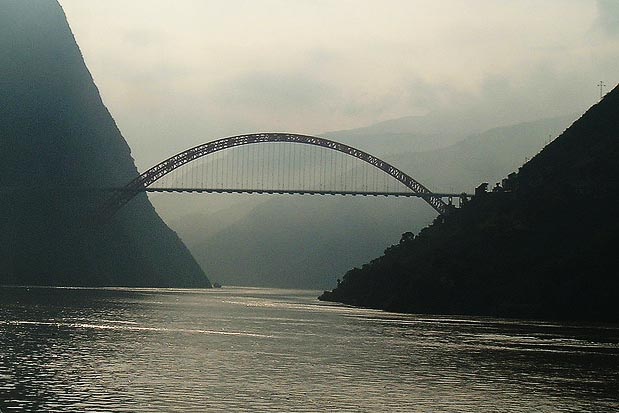
Three Gorges Cruise (China)
 guest post by Sanctuary Retreats
The Three Gorges area is one of the most impressive sites to visit in China. Formed by the Yangtze River it is, as the name suggests, split into three connecting gorges.
Qutang Gorge From east to west, Qutang Gorge measures five miles in total, running from Baidicheng all the way too the town of Daixi. The gorge is flanked by huge vertical cliffs, some thrusting thousands of meters into the air, the Yangtze River in between only a few dozens of meters wide forming a narrow gate way. With swash and rumble, the surging Yangtze River pours swiftly into the gateway. Looking up towards the tops of towering mountains along the gorge edge, only a narrow strip of clouds and sky can be seen by those on travelling on a luxury cruise down the river. Qutang Gorge is outstanding for its sheer scale and magnificence.
Wu Gorge Wu Gorge (Witches Gorge) extends 28 miles from the mouth of Daning River in the west to Guandukou of Badong in the east. The Wu Gorge is scattered with impressive peaks and lush surrounding mountains ranges. Its deep calm waters twist and turn their way down its length, allowing for those on China cruises to relax and soak in the surroundings. The twelve peaks of Wushan Mountain all rise up to meet the blue sky above. The mountains are formed of various fascinating shapes and among them is the breath taking Peak of Goddess. It raises high into the heavens, and towers over the Yangtze River. A protruding rock of the Peak has the shape of slim girl clad in a fine dress and often shrouded in clouds and mist.
Xiling Gorge Xiling Gorge measures 41 miles from Xiangxikou to Nanjinguan. Before the construction of the Three Gorges Dam, it was known for being the most dangerous of the three gorges to travel through. The whole Gorge area is covered with high mountains, gullies, shoals and reefs of various sizes. The best known shoal, Qing Shoal is formed by a collapsed craggy cliff. The gorge also comprises of many smaller gorges and never fail to provide fantastic and inspiring views for onlookers. Favourites include Kongling Gorge and Shadow Play Gorge.
Cruising down these gorges is an experience to treasure, as the natural sites afforded are surely one of the most unique on the planet.
Photo Credits: bridge, Qutang, Wu, Xiling
Sunday, April 24, 2011
The Alcazar of Seville (Spain) - A Historical Survivor

guest post (and photography) from Sandra Vallaure, editor of Seville Traveller, a website providing useful information on Seville for independent travellers
Seville is the most beautiful city in Spain. Actually, Spaniards often compare it to a woman and always define it as elegant, majestic and gorgeous. Additionally, it was one of the first Spanish cities founded by the Romans. As you can imagine, History has left its trace in Seville. As a result, the city is a combination of impressive monuments and narrow streets where you can wander as long as your feet permit it.
Among all the monuments Seville has, one stands out: the Alcazar.
The Alcazar is, together with the Cathedral and its bell tower, the Giralda, one of the main symbols of the city.
A little bit of history The area was initially occupied by the Romans and of the first Christian basilicas was built there. However, it not until the Arab occupation (844-1248) that the Alcazar was built, or at least part of it. When the Arabs finally conquered the city, they decided to create a structure for the governor that would be both a palace and a fortress. In fact, the Spanish word alcazar comes from the Arab al qsar that means palace, castle or fortress.
The Alcazar had the usual Arab architecture, and it was full of beautiful patios surrounded by thin columns supporting horseshoe arches. With the arrival and reconquest of the Christians leaded by King Ferdinand III, the Alcazar became the Royal Palace. From there on, the following kings ordered to perform alterations to adequate the complex to their needs and added further pavilions and structures.
Consequently, the Alcazar evolved into a unique place where you can find -and will actually see if you happen to visit it, a melting pot of Arab, Medieval, Renaissance and Baroque styles.
The Alcazar has been inhabited by most of the main kings and queens of Spanish history: Ferdinand III himself, the Catholic Monarchs, Charles V and many more. Even today, the King Juan Carlos I occupies the Alcazar when he is in Seville.
Don't miss...
I particularly recommend to pay attention to the Ambassador's Hall (Salón de los Embajadores) located inside Don Pedro's palace, also known as Palacio Mudéjar. Every little detail has been taken care of and the ceramics are absolutely spectacular.
Moreover, spend some time at the Maidens' Courtyard (Patio de las Doncellas). It has been recently restored and it is one of the finest examples of an Arab patio that can be found in Seville and, I dare to say, Spain. Finally, don't miss the gardens. They are magnificent. In truth there is not only one big garden but multiple small ones, every one with a different style and plants. There is even a labyrinth!
The smell of the orange trees, spread everywhere and the sound of the water flowing at the various fountains will charm you. I believe that one of the highlights of the Alcazar is to seat for a while and relax while observing all this nature surrounding you.
The Alcazar is an architectural masterpiece that explains on itself a large period of the history of Spain and Seville. On top of it, it is one of the finest examples of the Arab style of the 10th century. Sometimes how, after earthquakes, wars and fires, it has managed to survive.
So why not going to Seville during your next holiday? You will have the opportunity to enjoy one of the nicest European climates while devoting your time to discover wonders like the Alcazar.
Are you planning to visit the Alcazar? Have you done so already? Share with us your experience in the comments below!
Thursday, April 21, 2011
The Largest Church in the World?

 Where is the biggest church in the world?
St. Peters in the Vatican seems a likely guess. Maybe somewhere else in Italy? Milan? Venice? Spain and Portugal have some huge cathedrals. Maybe Canterbury, seat of the head of the Church of England. There are some big churches in Mexico and South America with their strong Catholic populations. The cathedrals in New York and Washington DC are gigantic too.
The remarkable thing is that with all these thoughts we aren't even on the correct continent. The largest church in the world is the Basilica of Our Lady of Peace (Notre Dame de la Paix) in Yamoussoukro in the troubled and impoverished west African country of Ivory Coast (or Cote D'Ivoire).  The brainchild of an enthusiastic (or is that, eccentric?) Ivory Coast president (now passed away), Yamoussoukro Basilica was constructed in the late 1980s consuming up to 25 percent of the nation's annual budget for several years. Modelled on St. Peter’s with its huge courtyard and opened by the Pope in 1990 after much debate, this incredible complex can be seen for miles around. Yamoussoukro was only a small village (population under 200) before the president of the time decreed his town of birth as the new capital. The surrounding grand multi-lane boulevards is reminiscent of Paris but almost completely without traffic or activity. The capital has since returned to the largest city of Abidjan.
 The dome on the basilica is massive (larger than St. Peters) but the most striking is the mass of stained glass. One noteworthy image shows Jesus Christ with the president and the chief architect.
 About the only other building of any scale is the old Presidential Palace. Today it is the burial site for the former president. It isn't open to the public but visitors can walk around the perimeter of the palace to see the human guards along with a number of crocodiles. These get fed every afternoon in quite a flamboyant show. It was reassuring that they were well fed as the fencing appeared to be little more than a few random strands of wire, unlikely to restrain any crocodile with hunger pangs.
Attending a church service in the basilica is an uplifting experience. Primarily in French, though also in some of the local tribal dialects, the service I attended went for over two hours. The attendance wasn’t huge but the lack of numbers was made up by the superb evangelical singing and the fantastic colour in the outfits of the African women, which went a long way to complementing the dazzling stained glass lit in the intense morning sunshine.
Photo credit: Stained glass

Monday, April 18, 2011
Photo of the Week: The Curiosity Shop (Jenolan Caves, Australia)

At 380 million years, Jenolan Caves are thought to be the oldest visited caves in the world. Around two hours drive west of Sydney, ten caves are open to the public. This photo shows the mesmerising beauty of the Orient Cave visited recently with my close and treasured friend Kath. The cave features three exceptionally featured rooms evocatively called the Indian, Egyptian and Persian Cambers. The formation is appropriately called The Curiosity Shop and includes helictites that are the strange formations that grow in all directions defying gravity (and scientific explanation).

Subscribe to:
Comments (Atom)